The post Engagement Is Not Communication appeared first on Aluminati Network Group.
]]>In Article 1 of this series, “The Illusion of the CRM: CRM vs Alumni Networking Platform, and Why You Need Both”, I made the case that CRM systems and alumni networking platforms serve fundamentally different functions. A CRM manages records and transactions. A dedicated alumni platform builds relationships. Most companies need both.
But owning both does not guarantee engagement.
That is the gap I want to close here.
87% of organizations running alumni programs say they need better engagement. Yet 80% still point to blogs, social posts, and e-newsletters as their primary channels. That gap is not a communication problem. It is an infrastructure problem.
Here is what most CRM-led programs actually measure versus what actually matters:
- What they measure: email open rates, event sign-ups, newsletter subscribers
- What actually matters: boomerang hires, referral quality, advocacy actions, mentoring uptake, introductions to new business
- What the gap reveals: a system built for broadcasting, not for value exchange
If your strategy relies on broadcasting, you are not engaging. You are making noise.
This article answers the practical questions – what features matter, what stack you need, what metrics prove ROI. But it answers them through one lens: the operating model that turns former employees into a measurable business asset.
Why the CRM-Led Alumni Database Model Breaks
CRM systems are built for quarterly sales cycles. They move prospects through a pipeline, close transactions, and hand off to the next stage. That logic works for revenue operations. It does not work for multi-decade alumni relationships.
When companies force alumni journeys into CRM architecture, the result is predictable. Stale records. Fragmented ownership. Weak personalization. No visibility into actual participation. The system was never designed to track whether a former employee mentored someone, made a referral, or introduced a client. It was designed to track whether they opened an email.
That is a fundamental design mismatch.
The deeper problem is data silos. Alumni data sits in the ATS, the HRIS, the email platform, and the CRM itself. Different records, different update cadences, different owners. The result is inaccurate data, duplicated contacts, and engagement strategies built on a foundation that no one fully trusts.
Layering AI on top of this fragmentation does not solve the problem. It accelerates it. Each new tool creates technical debt trying to compensate for gaps the underlying architecture was never designed to close.
“Corporate CRMs are built for quarterly speed. Forcing alumni journeys into sales funnels creates friction and missed opportunities.” – monday.com, 2026 CRM Guide
Here is how the two models compare at the operating level:
| Dimension | CRM-Led Database | Dedicated Alumni Infrastructure |
| Primary design purpose | Transaction management | Relationship continuity |
| Alumni identity over time | Static record | Dynamic, evolving profile |
| Peer-to-peer interaction | Not supported | Core feature |
| Personalization capability | Campaign-level | Individual behavior-driven |
| Integration with talent outcomes | Indirect, manual | Native, real-time |
| Measurable engagement signals | Open rates, clicks | Referrals, mentoring, rehires, advocacy |
| Data ownership | Shared across systems | Centralized, owned |
| Scalability for alumni lifecycle | Low | High |
The issue is not whether CRM data has value. It does. The issue is whether CRM architecture can function as community infrastructure. It cannot.
From Archived Contacts to Active Relationship Capital
Most companies have not made this shift. The reframe is straightforward.
Former employees are not a communications audience. They are a source of rehiring efficiency, referral quality, advocacy reach, mentoring capacity, and market access. Your role is not to broadcast at them. It is to facilitate a network where value moves between alumni, current employees, and the business.
This is what owned relationship capital looks like in practice:
Step 1: Records
You have names, job titles, exit dates, and email addresses. That is administration. Necessary, but not sufficient. A database of former employees is not an alumni program. It is a contact list.
Step 2: Relationships
You build structured pathways for alumni to connect with each other, with current employees, and with the organization. Mentoring, peer groups, events, job boards, and advocacy workflows turn passive records into active participants. 70% of companies have already moved to third-party alumni platforms to make this shift, up 11% since 2022.
Step 3: Return
Participation generates measurable outcomes. Boomerang hires reduce time-to-productivity and cut recruitment costs. Referrals improve candidate quality. Advocacy strengthens the employer brand. Mentoring retains institutional knowledge. Introductions open commercial doors.
The strategic question changes from “How many emails did we send?” to “What business outcomes did this network produce?”
Leading platforms now prioritize real-time synchronization with core HR and CRM systems. That integration layer turns relationship activity into reportable business value – the kind that holds up in a CFO review.
What Features Actually Matter in a Corporate Alumni Platform
Most feature comparisons list capabilities without asking the harder question: does this create business value, or does it add complexity?
The right filter is not “does this platform have X?” It is “does X enable value exchange, participation, or a measurable outcome?” Apply that lens and the list shortens fast.
| Feature | What It Enables | Business Value |
| Peer networking and directories | Alumni connect with each other and current employees | Referrals, introductions, commercial access |
| Mentoring and matching | Structured knowledge transfer between alumni and employees | Retention, institutional knowledge, talent development |
| Job board and referral workflows | Alumni refer candidates and explore boomerang opportunities | Reduced hiring costs, higher candidate quality |
| Groups and micro-communities | Alumni cluster by function, cohort, region, or interest | Deeper participation, stronger advocacy, relevant content |
| Events management | Structured touchpoints beyond email | Repeat participation, relationship reinforcement |
| Direct messaging and real-time communication | Frictionless peer-to-peer contact | Network activation, faster value exchange |
| AI-driven matching and personalization | Tailored content, connections, and opportunities | Higher engagement frequency, relevant participation |
| Mobile-first access | Engagement without friction, on any device | Day-to-day participation, reduced drop-off |
| Advocacy and ambassador workflows | Alumni actively promote the employer brand | Employer brand reach, talent pipeline quality |
| Integration with HRIS and ATS | Alumni data syncs with core talent systems | Boomerang hire tracking, referral attribution, unified reporting |
| Analytics and participation dashboards | Visibility into who is active and what they are doing | ROI reporting, program justification, CFO-ready metrics |
| Branded, owned environment | Company controls the experience and the data | Data sovereignty, trust, long-term relationship continuity |
Integration Only Works When It Connects, Not Just Syncs
Integration matters only when it supports a connected engagement layer rather than another reporting silo. The goal is a unified view: alumni activity feeding back into talent systems so that a boomerang hire, a referral, or an advocacy action is traceable and attributable.
AI-driven matching should be evaluated by one standard: does it increase participation, referral activity, and opportunity flow? McKinsey research shows AI-driven personalization can lift engagement by around 25% when recommendations reflect actual user behavior. That is a meaningful signal for any program justifying its budget.
The Ownership Question
78% of alumni prefer to access benefits and programs online. A mobile-first, branded environment reduces the friction that kills participation. More importantly, it keeps the relationship inside an owned channel – not dependent on public platforms you do not control.
The business case for a dedicated platform is not about features. It is about whether the infrastructure you have built can generate the outcomes you are being asked to report.
The Metrics That Prove Corporate Alumni ROI
Open rates do not appear in a CFO’s investment review. Boomerang hires do. Referral conversion rates do. Advocacy reach does. If the metrics your alumni program produces cannot connect to talent outcomes, employer brand value, or commercial relationships, the program will always struggle to justify its budget.
A healthy corporate alumni community produces measurable signals across 4 categories:
- Talent outcomes: boomerang hire rate, time-to-productivity for returning employees, referral volume, referral-to-hire conversion, candidate quality scores
- Participation signals: repeat login rate, mentoring uptake, group activity, event return rate, direct message volume
- Advocacy indicators: employer brand mentions, referral source attribution, ambassador program participation, content sharing
- Relationship capital: introductions made, business development connections, partnership conversations initiated through the network
The reason most CRM-led programs cannot report these metrics is structural. A CRM captures campaign outputs. A dedicated alumni platform captures interaction patterns, network behavior, and participation depth. The data is fundamentally different because the architecture is fundamentally different.
Direct academic evidence strongly supports that segmented/personalized outreach increases engagement behaviors. The mechanism is not magic. It is relevance. When former employees receive content, opportunities, and connections that reflect their actual career profile and behavior, they participate. When they participate, they generate measurable business value – referrals, introductions, boomerang applications, and advocacy that a broadcast email cannot produce.
This is where the business case becomes commercially defensible. Not in the feature list. Not in the engagement dashboard. In the line items that show up when a CFO asks what the program actually produced.
Decision Test: Do You Have Alumni Infrastructure or Just Alumni Records?
If your current setup mainly stores data, sends updates, and logs attendance, it is administration infrastructure. That has value. But it is not relationship infrastructure, and it will not produce the outcomes you are being asked to deliver.
Run this test against your current stack:
- Can alumni connect directly with each other and with current employees, without going through a company-managed intermediary?
- Does your platform support structured mentoring, peer groups, and advocacy workflows, or just communications?
- Can you track a boomerang hire, a referral, or a business introduction back to alumni network activity?
- Do alumni have a dynamic, evolving profile that reflects their career progression after leaving, or just an exit record?
- Is participation data feeding back into your talent and HR systems in real time, or sitting in a separate reporting silo?
If the honest answer to most of these is no, you have alumni records. Not alumni infrastructure.
As I covered in Article 1 of this series, “The Illusion of the CRM: CRM vs Alumni Networking Platform, and Why You Need Both”, the system architecture question matters. But architecture alone does not produce engagement. The operating model has to follow.
The shift from database to dynamic community is not a technology decision. It is a leadership decision about what your former employees are worth to the business, and whether you are willing to build the infrastructure that proves it.
If you are evaluating whether your current model is delivering, start with the 5 questions above. If you are building the case for a more structured approach, I am happy to have that conversation.
This is Article 2 in the “From Databases to Dynamic Communities” series.
Frequently Asked Questions
What is the difference between a CRM and a dedicated alumni engagement platform?
A CRM is built for transaction management – moving prospects through a pipeline and closing deals. A dedicated alumni platform is built for relationship continuity – supporting peer networking, mentoring, referrals, and long-term participation. The two systems serve fundamentally different purposes. Most companies need both, but only one can function as community infrastructure.
Why do most corporate alumni programs fail to generate measurable ROI?
Because they are built on broadcast logic. Sending newsletters and tracking open rates is administration, not engagement. Programs that produce measurable ROI – boomerang hires, referrals, advocacy, mentoring – are built on infrastructure that enables value exchange, not just outbound communication.
What features should I look for in a corporate alumni engagement platform?
Prioritize capabilities that create interaction and traceable outcomes: peer networking, mentoring and matching, job boards and referral workflows, advocacy tools, groups, events, direct messaging, and AI-driven personalization. Integration with your HRIS and ATS is essential so that alumni activity feeds back into talent reporting. Everything else is secondary.
How do I measure the ROI of a corporate alumni program?
Stop measuring campaign outputs and start measuring business outcomes. The metrics that matter: boomerang hire rate, referral-to-hire conversion, mentoring uptake, repeat participation, advocacy reach, and business introductions generated through the network. These are the numbers that hold up in a CFO review.
Can a CRM be configured to function as an alumni engagement platform?
In theory, yes. In practice, the configuration cost, technical debt, and ongoing maintenance make it a poor investment. CRMs lack native peer-to-peer interaction, identity continuity, and community-specific workflows. Companies that try to force alumni engagement into CRM architecture typically end up with stale records and low participation. A purpose-built platform is structurally better suited.
What is boomerang hiring and why does it matter for alumni strategy?
Boomerang hiring is the practice of rehiring former employees. It matters because returning employees ramp faster, already understand the culture, and typically perform at a higher level than external hires. A well-structured alumni network creates the conditions for boomerang hiring by keeping former employees engaged, informed, and connected to current opportunities.
How does AI improve corporate alumni engagement?
AI-driven personalization can lift engagement by around 25% when recommendations reflect actual user behavior. In practice, this means matching alumni to relevant job opportunities, mentoring partners, peer groups, and content based on their career trajectory and platform activity. The result is higher participation frequency and more relevant value exchange.
What is the risk of relying on LinkedIn as an alumni engagement channel?
LinkedIn is a public platform you do not own or control. Your alumni data sits on their infrastructure, subject to their algorithm and policy changes. You cannot track participation depth, run referral workflows, or integrate activity back into your talent systems. It is a useful awareness channel, not a substitute for owned relationship infrastructure.
How long does it take to build a productive corporate alumni community?
It depends on the size of your alumni base and the quality of your existing data. Companies that launch with a clear value proposition – job opportunities, mentoring, peer access, exclusive content – typically see meaningful participation within the first 90 days. The programs that stall are the ones that launch with a newsletter and call it a community.
When should a company invest in dedicated alumni infrastructure?
When the cost of not having it becomes visible. If you are losing boomerang hire opportunities, generating referrals at a low rate, struggling to justify your employer brand spend, or sitting on a database of former employees with no structured way to activate them – that is the signal. The business case is straightforward: owned relationship infrastructure produces measurable talent and commercial outcomes that a CRM list cannot.
The post Engagement Is Not Communication appeared first on Aluminati Network Group.
]]>The post The Illusion of the CRM: CRM vs Alumni Networking Platform, and Why You Need Both appeared first on Aluminati Network Group.
]]>I have spent years working with institutions that are proud of their alumni databases. Tens of thousands of records. Carefully maintained contact fields. Export-ready segments. And almost no meaningful engagement.
That gap, between the data an organization holds and the relationships it actually has, is the central problem in alumni strategy today. Most organizations believe they own their alumni relationships because they own their data. They don’t.
A CRM is an archive of what was once true. A community is a living reflection of what is true now.
Data is an archive. A community is an ecosystem. Confusing the two is both a technology mistake and a leadership oversight.
The alumni database software market is currently worth USD 1.16 billion, according to Research and Markets. That is a significant institutional investment in systems that store information. The harder question, the one most procurement conversations never reach, is whether that investment is building relationships or simply cataloguing them.
This article is about that distinction. And why the question most leaders are asking, CRM vs networking platform, is the wrong place to start.
Why ‘Alumni Database Software vs Networking Platform’ Is the Wrong Question
When alumni leaders search for alumni database software vs networking platform, they are looking for a clear answer. The problem is that the question itself forces a binary choice that does not reflect how an effective alumni strategy actually works.
These two categories solve fundamentally different problems. Understanding that distinction is the starting point for better infrastructure decisions.
| Alumni Database Software | Alumni Networking Platform | |
| Primary function | System of record | System of engagement |
| What it manages | Contacts, segments, compliance, reporting | Profiles, groups, events, mentoring, interaction |
| Data direction | Institutional to alumni (outbound) | Alumni to alumni and institution (bidirectional) |
| Participation model | Passive storage | Active participation |
| Core value | Governance and segmentation | Relationship vitality and return visits |
The distinction matters because alumni communities are built to create engagement (which then turns to ROI), and data storage is not exactly a conducive environment for engagement.
Modern alumni platforms include events modules, job boards, groups, networks, knowledge centers, and engagement tools that create a 360-degree view of alumni activity. These can often integrate with HR Systems, Business CRMs, Event Management Systems, and Document Management Systems. That integration is a shift in how institutions think about alumni infrastructure, which becomes part of the overall structural management of the company.
The institutions making that shift are not choosing between a database and a platform. They are building both and connecting them.
What a Database Can Do, and What It Cannot
I want to be precise here, because this argument is sometimes misread as an attack on CRM. It is not.
A well-maintained alumni database is genuinely valuable. It is the institutional memory of your community. Without it, you cannot segment outreach, manage consent and compliance, report on engagement over time, or build the kind of targeted campaigns that drive meaningful results.
What a strong alumni database delivers
- Centralized contact records and historical engagement data
- Segmentation by geography, work history, or demographic data
- Compliance and data governance across GDPR and corporate policy
- Reporting infrastructure for alumni leaders and corporate sponsors
What it cannot do on its own
What a database cannot do is give alumni a reason to return. It cannot create peer-to-peer interaction, facilitate mentoring, offer relevant job opportunities, run events with feedback loops, or generate the kind of ongoing participation that keeps records accurate and relationships active.
People today have access to other sophisticated digital platforms, often structured around algorithms that allow them to rapidly and efficiently find what they are looking for. Alumni do not want to be contacted only when the company needs something or wants to communicate with them one-way. They want ongoing access to a community that serves their professional and personal interests.
A database, on its own, cannot deliver that. It creates a contactable audience. Not an active community.
The Real Failure Is Stale Data
Here is where the strategic risk becomes concrete.
Alumni careers move fast. People change employers, relocate, shift industries, take on new responsibilities. If your alumni records are not moving with them, your segmentation is degrading silently, and your outreach becomes less relevant with every email or newsletter you send.
Stale data is a strategic failure.
If your data does not move at the speed of your alumni’s careers and evolving expectations, your strategy is obsolete before it begins.
Consider what stale records actually cost:
- Relevance decay. Outreach based on outdated job titles, employers, or locations misses the mark and erodes trust.
- Segmentation collapse. The more records drift from reality, the less useful your targeting becomes.
- Lost visibility. You cannot identify future advocates, boomerangs, or mentors from data that no longer reflects who your alumni are.
- Wasted team effort. Small alumni teams spend time manually chasing updates that a connected system should surface automatically.
This is where Social Data Sync becomes operationally significant. Rather than waiting for alumni to update their own profiles, or relying on periodic data cleansing exercises, Social Data Sync keeps institutional records aligned with real-world career movements. It is not a feature, it is the mechanism that stops your database from becoming an archive.
Sector research shows that organizations using segmented, targeted outreach see roughly 25% higher event participation than those relying on broad-based communication. That uplift depends entirely on data quality. And data quality depends on data that moves.
A Better Model: System of Record Plus System of Engagement
The organizations that are getting this right are not debating CRM vs platform. They have moved past that framing entirely. They are building connected infrastructure: a system of record working alongside a system of engagement, with data flowing between them.
Here is what that model looks like in practice.
1. System of record
Your CRM is the foundation. It stores institutional truth: contact permissions, historical engagement, segmentation data, compliance records, and advancement history. It is the layer that governance and reporting depend on.
Without a reliable system of record, you cannot make confident decisions about who to contact, when, or why.
2. System of engagement
Your alumni networking platform is where relationships become active. It is where alumni update their own profiles, join interest groups, search for jobs, participate in mentoring, register for events, and connect with peers.
Critically, every interaction on the engagement layer generates a signal. Who is active? Who is returning? Who is mentoring? Who has updated their career information? Who clicked on that job offer? Those signals flow back into the system of record, keeping data fresh and outreach relevant.
The shift this creates is from data ownership to network vitality. You move from knowing who your alumni were to understanding who they are now, and what they are willing to do.
According to sector analysis from 2025-2026, the strongest alumni programs are those that connect participation data to advancement strategy, rather than treating engagement and database management as separate workstreams.
That connection is the model that shapes the future success of your alumni initiative.
What Leaders Should Evaluate Instead of Feature Lists
When I speak with alumni leaders who are evaluating alumni infrastructure, the conversation too often starts with features. Job boards. Event management. Email automation. Engagement tracking. These matter, but they are not the right starting point.
The right starting point is outcomes. What benefits do organizations and alumni expect from each other?
An executive evaluation checklist
- Does engagement data flow back into institutional records automatically? If participation signals stay locked inside the engagement platform and never update your system of record, you are running two separate silos, not an integrated strategy.
- What does your active member rate actually look like? Database size is not a proxy for community health. Measure repeat event attendance, job searches, groups participation, profile update frequency, and regular logins.
- Can your team personalise outreach without adding operational overhead? Lean alumni teams need infrastructure that surfaces the right people at the right time, not systems that require manual segmentation before every event.
- Do you own your data and your community environment? Social platforms like LinkedIn or Facebook can support discovery and alumni reach, but they cannot replace a governed, branded, institution-owned community. You have no visibility into who is engaging with whom, no data portability, and no control over the experience.
The question is not which single tool does everything. The question is whether your infrastructure is designed to increase alumni engagement as a continuous outcome, not just as an event-by-event effort.
Measure Vitality, Not Database Size
The database is only one part of the infrastructure. The institutions that will lead in alumni engagement over the next decade are not the ones with the largest contact lists. They are the ones who know which alumni are actually active and have the systems to act on that knowledge continuously.
Before your next infrastructure review, I would ask you one question: what percentage of your alumni database is genuinely active right now?
Not contactable. Not on record. Active.
If you do not have a confident answer, that is the gap your strategy needs to close.
In the next article in this series, I will address exactly how to measure that. Not database size, but network vitality: the metrics, signals, and leadership frameworks that tell you whether your alumni community is growing stronger or quietly losing momentum.
This is Article 1 in the series: From Databases to Dynamic Communities.
Frequently Asked Questions
What is the difference between alumni database software and a networking platform? Alumni database software is a system of record. It stores contact details, permissions, segmentation, and reporting. A networking platform is a system of engagement. It helps alumni interact through profiles, groups, mentoring, events, and peer connections. Most institutions need both to keep data current and participation active.
Why is the database vs networking platform question the wrong one? It forces a false choice. A database is built to manage truth, governance, and compliance. A networking platform is built to create participation and return visits. The strongest alumni strategy connects both, so records stay accurate while the community remains active and visible.
Can a database alone improve alumni engagement? No. A database can support segmentation and outreach, but it cannot create reasons for alumni to return, update their profiles, or connect with each other. Engagement depends on interaction, relevance, and repeated participation, which requires a community layer.
What is Social Data Sync in alumni strategy? Social Data Sync helps keep alumni records aligned with real career movement. Instead of relying only on manual updates, it reflects changes in roles, employers, and locations back into the institution’s data. That reduces stale records and makes outreach more relevant.
Why does stale alumni data matter? Stale data weakens timing, relevance, and trust. If job titles, employers, or locations are out of date, outreach misses the mark and segmentation becomes less useful. Over time, the institution loses visibility into who is active, who is ready to help, and who has moved on.
What should leaders measure instead of database size? Measure active member rate, repeat event attendance, mentoring activity, profile freshness, and participation between campaigns. These signals show whether the network is alive, not just how many records are stored in the system.
How does a system of engagement help lean alumni teams? It reduces manual work by capturing fresh signals automatically. When alumni self-update profiles, attend events, or join groups, the team gets usable data without constantly chasing it. That makes personalisation and follow-up more scalable.
Are LinkedIn groups or Facebook groups enough for alumni engagement? They can help with discovery and early community building, but they do not replace owned infrastructure. Institutions need governed data, full visibility, and control over the experience. Social platforms can support the journey, but they cannot run it.
How does connected alumni infrastructure improve participation? When engagement data flows back into records, teams can target the right people with the right message at the right time. That improves relevance and typically supports higher participation, especially for events, mentoring, and volunteer activity.
What should I ask when choosing alumni software? Ask whether the platform only stores records or also drives participation. Check whether engagement signals feed back into the CRM, whether alumni can self-update their data, and whether the system helps your team increase activity without adding admin burden.
The post The Illusion of the CRM: CRM vs Alumni Networking Platform, and Why You Need Both appeared first on Aluminati Network Group.
]]>The post Alumni Engagement Platform Features to Look For appeared first on Aluminati Network Group.
]]>
I have watched large financial institutions fail at corporate alumni platforms.
Not because they chose the wrong software. Not because the vendor underdelivered. They failed because they launched a platform before answering the most important question in alumni strategy:
What is this network actually for?
That question sounds obvious. In practice, it is the one most organizations skip. They go straight to demos, feature comparisons, and procurement scorecards. By the time the platform goes live, nobody owns the purpose, and the technology fills the vacuum with noise.
The data is clear
At Aluminati, we see this pattern consistently. Networks built with 8 to 10 modules but no personalization or segmentation strategy generate active participation rates between 20% and 33%. Networks built around 3 focused modules with strong segmentation and a clear member journey generate active rates between 65% and 83%.
That is not a feature problem. That is a goal problem.
More capability without more clarity does not produce more engagement. It produces more confusion.
Start with the goal, not the platform
Think of it this way. A good supermarket does not push every product at every customer the moment they walk through the door. It helps people find what they came for. The layout reflects how customers actually shop, not what the store wants to sell.
Corporate alumni platforms work the same way. When a network tries to serve every possible alumni need simultaneously, it serves none of them well. Members cannot find what is relevant to them. Adoption stalls. Teams revert to email lists and spreadsheets.
Before you evaluate a single feature, define the goal.
- Is this network for talent continuity and boomerang hiring?
- Is it for business development and referral activation?
- Is it for brand advocacy and institutional knowledge?
- Is it for all three, with distinct journeys for each group?
The answer shapes everything that follows: which modules matter, how the platform should be configured, and what success looks like 18 months after launch.
Technology without purpose creates noise. Goal clarity creates value.
The feature checklist is the wrong brief
Once goal clarity is established, most organizations make the same second mistake: they hand procurement a feature checklist and treat the evaluation like a software shopping exercise.
Feature comparison tables feel rigorous. They are easy to present to a board. They create the illusion of objectivity. But they measure the wrong thing.
Visible functionality is not the same as strategic fit.
A platform can demonstrate a polished directory, a mentoring workflow, a job board, and an events module in a 45-minute demo. None of that tells you whether the system can be configured around your governance model, connected to your CRM, or adapted as your alumni strategy evolves over three years.
As Procurify’s research on enterprise software procurement makes clear, implementations fail when organizations treat software as a purchase rather than a business transformation program. The buying framework determines the outcome before a single line of configuration is written.
The questions that matter are not on most procurement scorecards:
- Can this platform reflect our organizational structure and stakeholder segments?
- Does it integrate with the systems our talent, HR, and CRM teams already depend on?
- Can it be governed and permissioned for a multi-stakeholder corporate environment?
- Will it still fit when our alumni strategy expands into new use cases?
A feature list answers none of those questions. A strategic brief does.
“Implementations fail when they’re treated as software deployments instead of business transformation programs.” — Procurify
Feature parity is now table stakes
Here is the reality of the current market. The alumni engagement platform category is growing at roughly 15% CAGR through 2026, and the front-end feature sets have converged significantly. Directories, events, mentoring, messaging, job boards, and basic reporting are now standard across most credible platforms.
A longer feature list does not create more value if the system cannot be configured around actual workflows.
The table below shows where the real differentiation sits once commodity features are taken off the table.
| Commodity features (table stakes) | Strategic differentiators |
| Member directory | Configurable access controls and segmentation |
| Events management | Integration with CRM and HRIS systems |
| Mentoring workflows | Role-based permissions for multi-stakeholder environments |
| Job board | Custom user journeys by alumni segment |
| Messaging and communications | Governance and data ownership controls |
| Basic analytics | Behavioral analytics tied to business outcomes |
| Groups and communities | Modular architecture that scales with strategy |
As JoinIt’s buyer analysis notes, CRM integration has moved from a nice-to-have to a critical selection criterion. That shift is significant. It signals that buyers are no longer evaluating platforms on what they display, but on how they connect to the broader operating infrastructure.
Once core features become commodities, the buying lens has to shift to business fit and operational flexibility. A platform that scores well on a feature checklist but poorly on integration, configurability, and governance is not a good platform. It is a liability dressed as a solution.
The real specification is architectural flexibility
Architectural flexibility is not a technical term. It is a business requirement.
It means the platform can reflect how your organization actually works: your stakeholder segments, your access controls, your brand standards, your data flows, and your program goals. It means the system shapes itself around your operating model, not the other way around.
A rigid out-of-the-box platform forces the opposite trade-off. The organization adapts its strategy to the software. Workflows get simplified to fit what the system allows. Governance compromises get made because the platform cannot support the required permissions. Integration workarounds get built because the system was not designed to connect with your CRM or HRIS.
Each compromise is small at the time. Collectively, they accumulate into a platform that does not reflect how the business runs, and alumni feel it immediately.
Three traits that define architectural flexibility
- Configurable structure, not just configurable design
Branding and visual customization are not architectural flexibility. The real test is whether the platform can be structured around your specific alumni segments, stakeholder groups, regional chapters, business units, and permission layers without requiring bespoke development every time the strategy evolves.
- Integration-first design
Your alumni platform does not operate in isolation. It needs to connect with CRM systems, HRIS platforms, SSO providers, communications tools, and analytics infrastructure. Deloitte’s governance research consistently identifies data integration and control as critical in compliance-aware enterprise environments. A platform that cannot integrate cleanly creates data silos, weakens reporting, and undermines the business case.
- Modular scalability
The alumni strategy you launch today will not be the strategy you run in three years. Platforms built on modular architectures allow organizations to start with the use cases that matter most, then expand into referrals, boomerang hiring, mentoring, advocacy, and business development as the program matures. A monolithic system locks you into the decisions made at procurement.
“Buyers should prioritize architectural flexibility and integration capabilities over mere feature checklists to ensure long-term value from alumni engagement platforms.” — Dr. Emily Chen, Stratistics Market Research
Five questions smart executives ask before they compare features
If you are a CEO, CFO, Chief People Officer, or CHRO evaluating an alumni engagement platform, these are the questions that belong at the top of your brief – before any vendor demo, before any feature scorecard.
- Does this platform map to our actual alumni model and business priorities?
Not the generic alumni model. Yours. Your organizational structure, your stakeholder segments, your tenure and seniority profiles, your geographic spread. A platform that cannot reflect the way your alumni population actually breaks down will force you to flatten it into a single undifferentiated group. That is where engagement dies.
- How does it integrate with the systems we already depend on?
CRM, HRIS, SSO, communications platforms, analytics tools. JoinIt’s platform research identifies CRM integration as a critical selection criterion, not an optional add-on. If the platform cannot connect cleanly to your existing infrastructure, you will spend the first 18 months managing data reconciliation instead of building alumni value.
- What governance and data controls does it provide?
Corporate alumni programs operate in environments with compliance requirements, data sensitivity, and multi-stakeholder accountability. Role-based permissions, data residency controls, and audit capability are not IT concerns. They are executive risk concerns. Deloitte’s enterprise governance research is clear: control and oversight matter in complex organizational environments, and alumni data is no exception.
- Can workflows and experiences be configured without costly workarounds?
The gap between “we can configure that” in a demo and “we can configure that without a six-month development cycle” in production is where most platform disappointments originate. Test this specifically. Ask vendors to show you how a workflow change gets made, who owns it, and how long it takes.
- Will this still fit when our strategy expands?
Alumni programs that start with one use case – say, talent referrals – typically expand into mentoring, business development, advocacy, and knowledge continuity within two to three years. If the platform cannot scale modularly, you will face a replacement decision at exactly the point when the program is generating real value.
The right platform is not the one that wins the demo. It is the one that still fits the business three years after procurement.
This is an operating-model decision, not a software purchase
The strongest internal business case for an alumni engagement platform is not that a vendor offers more features than the competition. It is that the platform supports the operating model that creates long-term relationship value.
When a corporate alumni network is functioning well, it becomes part of the infrastructure for talent continuity and relationship capital. It is where former employees stay connected, where referrals surface, where boomerang hires originate, where institutional knowledge gets preserved, and where brand advocacy grows organically.
That is not a communications tool. That is a strategic asset.
The decision to invest in it belongs at the executive level because the outcomes it drives – reduced recruitment costs, stronger referral pipelines, faster rehiring cycles, and expanded business development networks – are executive-level metrics.
- Reduced time-to-hire through boomerang and referral pipelines
- Lower recruitment cost per hire for alumni-sourced candidates
- Measurable referral activation rates by alumni cohort
- Advocacy reach tied to alumni engagement activity
- Knowledge continuity metrics for high-value departing employees
PeoplePath’s research on corporate alumni strategy confirms that organizations which align platform selection to talent continuity and relationship outcomes outperform those that treat alumni programs as communications exercises.
The platform choice either supports that operating model or constrains it.
“The business case is simple. A corporate alumni network built on the right infrastructure pays for itself through the talent and relationship value it activates. The wrong platform does the opposite.”
The hidden cost of buying the wrong platform
Poor platform fit has two categories of cost. The visible ones are easy to quantify. The hidden ones are where the real damage sits.
| Visible costs | Hidden costs |
| Unused license spend | Lost relationship intelligence |
| Implementation overruns | Weakened reporting credibility with leadership |
| Integration workaround development | Slower execution as teams revert to manual tools |
| Retraining and change management | Political cost of a failed initiative |
| Replacement procurement cycle | Alumni disengagement that is difficult to reverse |
Penny’s research on platform adoption identifies a pattern that will be familiar to any executive who has inherited a failed software rollout: when complexity exceeds usability, teams revert to email and spreadsheets. Sixty percent of stakeholders revert to manual methods when platform adoption fails.
That reversion is not just an operational inconvenience. It means the relationship data you needed to build a business case for the program never gets captured. Without data, the program cannot prove its value. Without proof of value, it loses budget priority. The platform becomes a cost center instead of a strategic asset.
The real cost of poor platform fit is not the wasted license spend. It is the lost relationship capital and the organizational credibility that goes with it.
Buying the wrong platform is recoverable. But it costs time, political capital, and momentum that most programs cannot easily rebuild.
Stop buying features. Start building infrastructure.
The smartest executive buyers do not ask which platform has the most features. They ask which platform can support the way the company needs to create alumni value.
That starts with goal clarity. It runs through architectural flexibility, integration fit, and governance design. It ends with a platform that reflects the operating model and grows with the strategy.
If the platform cannot flex around business purpose, data reality, and long-term governance requirements, the feature list is irrelevant.
The specification is not a feature checklist. It is a definition of what your alumni ecosystem needs to achieve and whether the platform can be built around that.
I would like to hear from you. How are you approaching the design of your alumni ecosystem? Are you starting from organizational goals, or are you still working through the feature comparison stage? Share your thoughts in the comments.
This is the third article in a series on building corporate alumni networks that create measurable business value. The next article tackles a question that follows directly from platform selection: once the infrastructure is in place, how do you design the alumni experience itself so that engagement is not just activated but sustained? That is where most programs stall, and where the real operating model work begins.
Frequently Asked Questions
What features should I look for in an alumni engagement platform?
Look for segmentation, CRM integration, role-based permissions, governance controls, analytics, and configurable workflows. The point is not to collect features. It is to find a platform that fits your operating model and supports long-term alumni value.
Why is architectural flexibility more important than feature count?
Feature count tells you what a platform can show in a demo. Architectural flexibility tells you whether it can adapt to your structure, data, governance, and future use cases without constant workarounds or replatforming.
What does feature parity mean in alumni engagement platforms?
It means most credible platforms now offer the same core tools, like directories, events, mentoring, messaging, and reporting. Once that happens, the buying decision should shift from visible features to integration, governance, and scalability.
Why does CRM integration matter so much?
CRM integration keeps alumni data connected to the systems your organization already uses. Without it, teams create duplicates, reporting becomes unreliable, and adoption drops because staff have to manage disconnected tools manually.
How do I know if a platform supports governance needs?
Ask how it handles permissions, data access, auditability, and controls across different stakeholder groups. If it cannot support a multi-stakeholder corporate environment cleanly, it creates risk instead of reducing it.
Should I choose an out-of-the-box alumni platform?
Only if your strategy is simple and unlikely to change. Most corporate alumni programs evolve into referrals, rehiring, mentoring, advocacy, and relationship intelligence, which usually requires more flexibility than a standard setup offers.
What is the hidden cost of choosing the wrong platform?
It is not just wasted license spend. The bigger costs are weak adoption, manual workarounds, poor reporting credibility, lost relationship intelligence, and the political damage of a stalled initiative.
How should executive buyers evaluate alumni platform vendors?
They should ask whether the platform fits the organization’s goals, operating model, governance standards, and integration reality. The best vendor is the one that still fits once the program matures.
Why do feature scorecards often lead buyers astray?
Because they reward visible functionality, which creates false confidence. They rarely reveal whether the platform can be configured around real workflows, scale with the program, or support the outcomes leadership cares about.
What should be the first question before comparing platforms?
Ask what the alumni network is meant to achieve for the business and for alumni. Once the purpose is clear, the right features become easier to identify and the wrong platforms become easier to eliminate.
The post Alumni Engagement Platform Features to Look For appeared first on Aluminati Network Group.
]]>The post Engagement Is Not Communication appeared first on Aluminati Network Group.
]]>
In Article 1 of this series, “The Illusion of the CRM: CRM vs Alumni Networking Platform, and Why You Need Both”, I made the case that CRM systems and alumni networking platforms serve fundamentally different functions. A CRM manages records and transactions. A dedicated alumni platform builds relationships. Most companies need both.
But owning both does not guarantee engagement.
That is the gap I want to close here.
87% of organizations running alumni programs say they need better engagement. Yet 80% still point to blogs, social posts, and e-newsletters as their primary channels. That gap is not a communication problem. It is an infrastructure problem.
Here is what most CRM-led programs actually measure versus what actually matters:
- What they measure: email open rates, event sign-ups, newsletter subscribers
- What actually matters: boomerang hires, referral quality, advocacy actions, mentoring uptake, introductions to new business
- What the gap reveals: a system built for broadcasting, not for value exchange
If your strategy relies on broadcasting, you are not engaging. You are making noise.
This article answers the practical questions – what features matter, what stack you need, what metrics prove ROI. But it answers them through one lens: the operating model that turns former employees into a measurable business asset.
Why the CRM-Led Alumni Database Model Breaks
CRM systems are built for quarterly sales cycles. They move prospects through a pipeline, close transactions, and hand off to the next stage. That logic works for revenue operations. It does not work for multi-decade alumni relationships.
When companies force alumni journeys into CRM architecture, the result is predictable. Stale records. Fragmented ownership. Weak personalization. No visibility into actual participation. The system was never designed to track whether a former employee mentored someone, made a referral, or introduced a client. It was designed to track whether they opened an email.
That is a fundamental design mismatch.
The deeper problem is data silos. Alumni data sits in the ATS, the HRIS, the email platform, and the CRM itself. Different records, different update cadences, different owners. The result is inaccurate data, duplicated contacts, and engagement strategies built on a foundation that no one fully trusts.
Layering AI on top of this fragmentation does not solve the problem. It accelerates it. Each new tool creates technical debt trying to compensate for gaps the underlying architecture was never designed to close.
“Corporate CRMs are built for quarterly speed. Forcing alumni journeys into sales funnels creates friction and missed opportunities.” – monday.com, 2026 CRM Guide
Here is how the two models compare at the operating level:
| Dimension | CRM-Led Database | Dedicated Alumni Infrastructure |
| Primary design purpose | Transaction management | Relationship continuity |
| Alumni identity over time | Static record | Dynamic, evolving profile |
| Peer-to-peer interaction | Not supported | Core feature |
| Personalization capability | Campaign-level | Individual behavior-driven |
| Integration with talent outcomes | Indirect, manual | Native, real-time |
| Measurable engagement signals | Open rates, clicks | Referrals, mentoring, rehires, advocacy |
| Data ownership | Shared across systems | Centralized, owned |
| Scalability for alumni lifecycle | Low | High |
The issue is not whether CRM data has value. It does. The issue is whether CRM architecture can function as community infrastructure. It cannot.
From Archived Contacts to Active Relationship Capital
Most companies have not made this shift. The reframe is straightforward.
Former employees are not a communications audience. They are a source of rehiring efficiency, referral quality, advocacy reach, mentoring capacity, and market access. Your role is not to broadcast at them. It is to facilitate a network where value moves between alumni, current employees, and the business.
This is what owned relationship capital looks like in practice:
Step 1: Records
You have names, job titles, exit dates, and email addresses. That is administration. Necessary, but not sufficient. A database of former employees is not an alumni program. It is a contact list.
Step 2: Relationships
You build structured pathways for alumni to connect with each other, with current employees, and with the organization. Mentoring, peer groups, events, job boards, and advocacy workflows turn passive records into active participants. 70% of companies have already moved to third-party alumni platforms to make this shift, up 11% since 2022.
Step 3: Return
Participation generates measurable outcomes. Boomerang hires reduce time-to-productivity and cut recruitment costs. Referrals improve candidate quality. Advocacy strengthens the employer brand. Mentoring retains institutional knowledge. Introductions open commercial doors.
The strategic question changes from “How many emails did we send?” to “What business outcomes did this network produce?”
Leading platforms now prioritize real-time synchronization with core HR and CRM systems. That integration layer turns relationship activity into reportable business value – the kind that holds up in a CFO review.
What Features Actually Matter in a Corporate Alumni Platform
Most feature comparisons list capabilities without asking the harder question: does this create business value, or does it add complexity?
The right filter is not “does this platform have X?” It is “does X enable value exchange, participation, or a measurable outcome?” Apply that lens and the list shortens fast.
| Feature | What It Enables | Business Value |
| Peer networking and directories | Alumni connect with each other and current employees | Referrals, introductions, commercial access |
| Mentoring and matching | Structured knowledge transfer between alumni and employees | Retention, institutional knowledge, talent development |
| Job board and referral workflows | Alumni refer candidates and explore boomerang opportunities | Reduced hiring costs, higher candidate quality |
| Groups and micro-communities | Alumni cluster by function, cohort, region, or interest | Deeper participation, stronger advocacy, relevant content |
| Events management | Structured touchpoints beyond email | Repeat participation, relationship reinforcement |
| Direct messaging and real-time communication | Frictionless peer-to-peer contact | Network activation, faster value exchange |
| AI-driven matching and personalization | Tailored content, connections, and opportunities | Higher engagement frequency, relevant participation |
| Mobile-first access | Engagement without friction, on any device | Day-to-day participation, reduced drop-off |
| Advocacy and ambassador workflows | Alumni actively promote the employer brand | Employer brand reach, talent pipeline quality |
| Integration with HRIS and ATS | Alumni data syncs with core talent systems | Boomerang hire tracking, referral attribution, unified reporting |
| Analytics and participation dashboards | Visibility into who is active and what they are doing | ROI reporting, program justification, CFO-ready metrics |
| Branded, owned environment | Company controls the experience and the data | Data sovereignty, trust, long-term relationship continuity |
Integration Only Works When It Connects, Not Just Syncs
Integration matters only when it supports a connected engagement layer rather than another reporting silo. The goal is a unified view: alumni activity feeding back into talent systems so that a boomerang hire, a referral, or an advocacy action is traceable and attributable.
AI-driven matching should be evaluated by one standard: does it increase participation, referral activity, and opportunity flow? McKinsey research shows AI-driven personalization can lift engagement by around 25% when recommendations reflect actual user behavior. That is a meaningful signal for any program justifying its budget.
The Ownership Question
78% of alumni prefer to access benefits and programs online. A mobile-first, branded environment reduces the friction that kills participation. More importantly, it keeps the relationship inside an owned channel – not dependent on public platforms you do not control.
The business case for a dedicated platform is not about features. It is about whether the infrastructure you have built can generate the outcomes you are being asked to report.
The Metrics That Prove Corporate Alumni ROI
Open rates do not appear in a CFO’s investment review. Boomerang hires do. Referral conversion rates do. Advocacy reach does. If the metrics your alumni program produces cannot connect to talent outcomes, employer brand value, or commercial relationships, the program will always struggle to justify its budget.
A healthy corporate alumni community produces measurable signals across 4 categories:
- Talent outcomes: boomerang hire rate, time-to-productivity for returning employees, referral volume, referral-to-hire conversion, candidate quality scores
- Participation signals: repeat login rate, mentoring uptake, group activity, event return rate, direct message volume
- Advocacy indicators: employer brand mentions, referral source attribution, ambassador program participation, content sharing
- Relationship capital: introductions made, business development connections, partnership conversations initiated through the network
The reason most CRM-led programs cannot report these metrics is structural. A CRM captures campaign outputs. A dedicated alumni platform captures interaction patterns, network behavior, and participation depth. The data is fundamentally different because the architecture is fundamentally different.
Direct academic evidence strongly supports that segmented/personalized outreach increases engagement behaviors. The mechanism is not magic. It is relevance. When former employees receive content, opportunities, and connections that reflect their actual career profile and behavior, they participate. When they participate, they generate measurable business value – referrals, introductions, boomerang applications, and advocacy that a broadcast email cannot produce.
This is where the business case becomes commercially defensible. Not in the feature list. Not in the engagement dashboard. In the line items that show up when a CFO asks what the program actually produced.
Decision Test: Do You Have Alumni Infrastructure or Just Alumni Records?
If your current setup mainly stores data, sends updates, and logs attendance, it is administration infrastructure. That has value. But it is not relationship infrastructure, and it will not produce the outcomes you are being asked to deliver.
Run this test against your current stack:
- Can alumni connect directly with each other and with current employees, without going through a company-managed intermediary?
- Does your platform support structured mentoring, peer groups, and advocacy workflows, or just communications?
- Can you track a boomerang hire, a referral, or a business introduction back to alumni network activity?
- Do alumni have a dynamic, evolving profile that reflects their career progression after leaving, or just an exit record?
- Is participation data feeding back into your talent and HR systems in real time, or sitting in a separate reporting silo?
If the honest answer to most of these is no, you have alumni records. Not alumni infrastructure.
As I covered in Article 1 of this series, “The Illusion of the CRM: CRM vs Alumni Networking Platform, and Why You Need Both”, the system architecture question matters. But architecture alone does not produce engagement. The operating model has to follow.
The shift from database to dynamic community is not a technology decision. It is a leadership decision about what your former employees are worth to the business, and whether you are willing to build the infrastructure that proves it.
If you are evaluating whether your current model is delivering, start with the 5 questions above. If you are building the case for a more structured approach, I am happy to have that conversation.
This is Article 2 in the “From Databases to Dynamic Communities” series.
Frequently Asked Questions
What is the difference between a CRM and a dedicated alumni engagement platform?
A CRM is built for transaction management – moving prospects through a pipeline and closing deals. A dedicated alumni platform is built for relationship continuity – supporting peer networking, mentoring, referrals, and long-term participation. The two systems serve fundamentally different purposes. Most companies need both, but only one can function as community infrastructure.
Why do most corporate alumni programs fail to generate measurable ROI?
Because they are built on broadcast logic. Sending newsletters and tracking open rates is administration, not engagement. Programs that produce measurable ROI – boomerang hires, referrals, advocacy, mentoring – are built on infrastructure that enables value exchange, not just outbound communication.
What features should I look for in a corporate alumni engagement platform?
Prioritize capabilities that create interaction and traceable outcomes: peer networking, mentoring and matching, job boards and referral workflows, advocacy tools, groups, events, direct messaging, and AI-driven personalization. Integration with your HRIS and ATS is essential so that alumni activity feeds back into talent reporting. Everything else is secondary.
How do I measure the ROI of a corporate alumni program?
Stop measuring campaign outputs and start measuring business outcomes. The metrics that matter: boomerang hire rate, referral-to-hire conversion, mentoring uptake, repeat participation, advocacy reach, and business introductions generated through the network. These are the numbers that hold up in a CFO review.
Can a CRM be configured to function as an alumni engagement platform?
In theory, yes. In practice, the configuration cost, technical debt, and ongoing maintenance make it a poor investment. CRMs lack native peer-to-peer interaction, identity continuity, and community-specific workflows. Companies that try to force alumni engagement into CRM architecture typically end up with stale records and low participation. A purpose-built platform is structurally better suited.
What is boomerang hiring and why does it matter for alumni strategy?
Boomerang hiring is the practice of rehiring former employees. It matters because returning employees ramp faster, already understand the culture, and typically perform at a higher level than external hires. A well-structured alumni network creates the conditions for boomerang hiring by keeping former employees engaged, informed, and connected to current opportunities.
How does AI improve corporate alumni engagement?
AI-driven personalization can lift engagement by around 25% when recommendations reflect actual user behavior. In practice, this means matching alumni to relevant job opportunities, mentoring partners, peer groups, and content based on their career trajectory and platform activity. The result is higher participation frequency and more relevant value exchange.
What is the risk of relying on LinkedIn as an alumni engagement channel?
LinkedIn is a public platform you do not own or control. Your alumni data sits on their infrastructure, subject to their algorithm and policy changes. You cannot track participation depth, run referral workflows, or integrate activity back into your talent systems. It is a useful awareness channel, not a substitute for owned relationship infrastructure.
How long does it take to build a productive corporate alumni community?
It depends on the size of your alumni base and the quality of your existing data. Companies that launch with a clear value proposition – job opportunities, mentoring, peer access, exclusive content – typically see meaningful participation within the first 90 days. The programs that stall are the ones that launch with a newsletter and call it a community.
When should a company invest in dedicated alumni infrastructure?
When the cost of not having it becomes visible. If you are losing boomerang hire opportunities, generating referrals at a low rate, struggling to justify your employer brand spend, or sitting on a database of former employees with no structured way to activate them – that is the signal. The business case is straightforward: owned relationship infrastructure produces measurable talent and commercial outcomes that a CRM list cannot.
The post Engagement Is Not Communication appeared first on Aluminati Network Group.
]]>The post The Illusion of the CRM: Alumni Database vs Networking Platform appeared first on Aluminati Network Group.
]]>I have spent years working with institutions that are proud of their alumni databases. Tens of thousands of records. Carefully maintained contact fields. Export-ready segments. And almost no meaningful engagement.
That gap, between the data an organization holds and the relationships it actually has, is the central problem in alumni strategy today. Most organizations believe they own their alumni relationships because they own their data. They don’t.
A CRM is an archive of what was once true. A community is a living reflection of what is true now.
Data is an archive. A community is an ecosystem. Confusing the two is both a technology mistake and a leadership oversight.
The alumni database software market is currently worth USD 1.16 billion, according to Research and Markets. That is a significant institutional investment in systems that store information. The harder question, the one most procurement conversations never reach, is whether that investment is building relationships or simply cataloguing them.
This article is about that distinction. And why the question most leaders are asking, CRM vs networking platform, is the wrong place to start.
Why ‘Alumni Database Software vs Networking Platform’ Is the Wrong Question
When alumni leaders search for alumni database software vs networking platform, they are looking for a clear answer. The problem is that the question itself forces a binary choice that does not reflect how an effective alumni strategy actually works.
These two categories solve fundamentally different problems. Understanding that distinction is the starting point for better infrastructure decisions.
| Alumni Database Software | Alumni Networking Platform | |
| Primary function | System of record | System of engagement |
| What it manages | Contacts, segments, compliance, reporting | Profiles, groups, events, mentoring, interaction |
| Data direction | Institutional to alumni (outbound) | Alumni to alumni and institution (bidirectional) |
| Participation model | Passive storage | Active participation |
| Core value | Governance and segmentation | Relationship vitality and return visits |
The distinction matters because alumni communities are built to create engagement (which then turns to ROI), and data storage is not exactly a conducive environment for engagement.
Modern alumni platforms include events modules, job boards, groups, networks, knowledge centers, and engagement tools that create a 360-degree view of alumni activity. These can often integrate with HR Systems, Business CRMs, Event Management Systems, and Document Management Systems. That integration is a shift in how institutions think about alumni infrastructure, which becomes part of the overall structural management of the company.
The institutions making that shift are not choosing between a database and a platform. They are building both and connecting them.
What a Database Can Do, and What It Cannot
I want to be precise here, because this argument is sometimes misread as an attack on CRM. It is not.
A well-maintained alumni database is genuinely valuable. It is the institutional memory of your community. Without it, you cannot segment outreach, manage consent and compliance, report on engagement over time, or build the kind of targeted campaigns that drive meaningful results.
What a strong alumni database delivers
- Centralized contact records and historical engagement data
- Segmentation by geography, work history, or demographic data
- Compliance and data governance across GDPR and corporate policy
- Reporting infrastructure for alumni leaders and corporate sponsors
What it cannot do on its own
What a database cannot do is give alumni a reason to return. It cannot create peer-to-peer interaction, facilitate mentoring, offer relevant job opportunities, run events with feedback loops, or generate the kind of ongoing participation that keeps records accurate and relationships active.
People today have access to other sophisticated digital platforms, often structured around algorithms that allow them to rapidly and efficiently find what they are looking for. Alumni do not want to be contacted only when the company needs something or wants to communicate with them one-way. They want ongoing access to a community that serves their professional and personal interests.
A database, on its own, cannot deliver that. It creates a contactable audience. Not an active community.
The Real Failure Is Stale Data
Here is where the strategic risk becomes concrete.
Alumni careers move fast. People change employers, relocate, shift industries, take on new responsibilities. If your alumni records are not moving with them, your segmentation is degrading silently, and your outreach becomes less relevant with every email or newsletter you send.
Stale data is a strategic failure.
If your data does not move at the speed of your alumni’s careers and evolving expectations, your strategy is obsolete before it begins.
Consider what stale records actually cost:
- Relevance decay. Outreach based on outdated job titles, employers, or locations misses the mark and erodes trust.
- Segmentation collapse. The more records drift from reality, the less useful your targeting becomes.
- Lost visibility. You cannot identify future advocates, boomerangs, or mentors from data that no longer reflects who your alumni are.
- Wasted team effort. Small alumni teams spend time manually chasing updates that a connected system should surface automatically.
This is where Social Data Sync becomes operationally significant. Rather than waiting for alumni to update their own profiles, or relying on periodic data cleansing exercises, Social Data Sync keeps institutional records aligned with real-world career movements. It is not a feature, it is the mechanism that stops your database from becoming an archive.
Sector research shows that organizations using segmented, targeted outreach see roughly 25% higher event participation than those relying on broad-based communication. That uplift depends entirely on data quality. And data quality depends on data that moves.
A Better Model: System of Record Plus System of Engagement
The organizations that are getting this right are not debating CRM vs platform. They have moved past that framing entirely. They are building connected infrastructure: a system of record working alongside a system of engagement, with data flowing between them.
Here is what that model looks like in practice.
1. System of record
Your CRM is the foundation. It stores institutional truth: contact permissions, historical engagement, segmentation data, compliance records, and advancement history. It is the layer that governance and reporting depend on.
Without a reliable system of record, you cannot make confident decisions about who to contact, when, or why.
2. System of engagement
Your alumni networking platform is where relationships become active. It is where alumni update their own profiles, join interest groups, search for jobs, participate in mentoring, register for events, and connect with peers.
Critically, every interaction on the engagement layer generates a signal. Who is active? Who is returning? Who is mentoring? Who has updated their career information? Who clicked on that job offer? Those signals flow back into the system of record, keeping data fresh and outreach relevant.
The shift this creates is from data ownership to network vitality. You move from knowing who your alumni were to understanding who they are now, and what they are willing to do.
According to sector analysis from 2025-2026, the strongest alumni programs are those that connect participation data to advancement strategy, rather than treating engagement and database management as separate workstreams.
That connection is the model that shapes the future success of your alumni initiative.
What Leaders Should Evaluate Instead of Feature Lists
When I speak with alumni leaders who are evaluating alumni infrastructure, the conversation too often starts with features. Job boards. Event management. Email automation. Engagement tracking. These matter, but they are not the right starting point.
The right starting point is outcomes. What benefits do organizations and alumni expect from each other?
An executive evaluation checklist
- Does engagement data flow back into institutional records automatically? If participation signals stay locked inside the engagement platform and never update your system of record, you are running two separate silos, not an integrated strategy.
- What does your active member rate actually look like? Database size is not a proxy for community health. Measure repeat event attendance, job searches, groups participation, profile update frequency, and regular logins.
- Can your team personalise outreach without adding operational overhead? Lean alumni teams need infrastructure that surfaces the right people at the right time, not systems that require manual segmentation before every event.
- Do you own your data and your community environment? Social platforms like LinkedIn or Facebook can support discovery and alumni reach, but they cannot replace a governed, branded, institution-owned community. You have no visibility into who is engaging with whom, no data portability, and no control over the experience.
The question is not which single tool does everything. The question is whether your infrastructure is designed to increase alumni engagement as a continuous outcome, not just as an event-by-event effort.
Measure Vitality, Not Database Size
The database is only one part of the infrastructure. The institutions that will lead in alumni engagement over the next decade are not the ones with the largest contact lists. They are the ones who know which alumni are actually active and have the systems to act on that knowledge continuously.
Before your next infrastructure review, I would ask you one question: what percentage of your alumni database is genuinely active right now?
Not contactable. Not on record. Active.
If you do not have a confident answer, that is the gap your strategy needs to close.
In the next article in this series, I will address exactly how to measure that. Not database size, but network vitality: the metrics, signals, and leadership frameworks that tell you whether your alumni community is growing stronger or quietly losing momentum.
This is Article 1 in the series: From Databases to Dynamic Communities.
Frequently Asked Questions
What is the difference between alumni database software and a networking platform? Alumni database software is a system of record. It stores contact details, permissions, segmentation, and reporting. A networking platform is a system of engagement. It helps alumni interact through profiles, groups, mentoring, events, and peer connections. Most institutions need both to keep data current and participation active.
Why is the database vs networking platform question the wrong one? It forces a false choice. A database is built to manage truth, governance, and compliance. A networking platform is built to create participation and return visits. The strongest alumni strategy connects both, so records stay accurate while the community remains active and visible.
Can a database alone improve alumni engagement? No. A database can support segmentation and outreach, but it cannot create reasons for alumni to return, update their profiles, or connect with each other. Engagement depends on interaction, relevance, and repeated participation, which requires a community layer.
What is Social Data Sync in alumni strategy? Social Data Sync helps keep alumni records aligned with real career movement. Instead of relying only on manual updates, it reflects changes in roles, employers, and locations back into the institution’s data. That reduces stale records and makes outreach more relevant.
Why does stale alumni data matter? Stale data weakens timing, relevance, and trust. If job titles, employers, or locations are out of date, outreach misses the mark and segmentation becomes less useful. Over time, the institution loses visibility into who is active, who is ready to help, and who has moved on.
What should leaders measure instead of database size? Measure active member rate, repeat event attendance, mentoring activity, profile freshness, and participation between campaigns. These signals show whether the network is alive, not just how many records are stored in the system.
How does a system of engagement help lean alumni teams? It reduces manual work by capturing fresh signals automatically. When alumni self-update profiles, attend events, or join groups, the team gets usable data without constantly chasing it. That makes personalisation and follow-up more scalable.
Are LinkedIn groups or Facebook groups enough for alumni engagement? They can help with discovery and early community building, but they do not replace owned infrastructure. Institutions need governed data, full visibility, and control over the experience. Social platforms can support the journey, but they cannot run it.
How does connected alumni infrastructure improve participation? When engagement data flows back into records, teams can target the right people with the right message at the right time. That improves relevance and typically supports higher participation, especially for events, mentoring, and volunteer activity.
What should I ask when choosing alumni software? Ask whether the platform only stores records or also drives participation. Check whether engagement signals feed back into the CRM, whether alumni can self-update their data, and whether the system helps your team increase activity without adding admin burden.
The post The Illusion of the CRM: Alumni Database vs Networking Platform appeared first on Aluminati Network Group.
]]>The post Web Developer appeared first on Aluminati Network Group.
]]>- Competitive salary, £35-£40k depending on experience
- Discretionary annual company bonus based on performance
- Medical Health Insurance
- Flexible working hours
- 25 days holiday + bank holidays
- Long service bonus holiday allowance
- Free parking
Working Hours
Full Time, Permanent
9am – 5.30pm
Some flexibility
Reports to
Head of Development
Team
There are currently 8 developers in the team, who report to the Head of Development. Our
developers work very closely with the client support team.
Technical Skills
The ideal candidate will have at least 2 years’ experience with Vue (preferably), React or a similar
JavaScript framework, as well as experience with SQL. HTML and CSS proficiency are expected,
and it would be preferable if you have experience with NodeJS and GIT.
Additional knowledge of any of the following would be desirable: Elastic search, Typescript,
PHP, browser compatibility Issues, database management, Linux command line.
Desirable Attributes
The successful candidate will be an efficient and organised team player with a logical and
hardworking approach. The ability to communicate with people with various levels of technical
proficiency would be useful. A degree qualification or equivalent would be beneficial but is not
essential.
Key Responsibilities
- Design & develop dynamic web applications and new online innovations, either individually or as part of a team on large projects.
- Maintain existing online applications and services.
- Develop internal systems and processes
- Assist the helpdesk in resolving code-related end-user issues.
- Work with our client service team to create feature specifications & investigate issue reports
- Support peers with technical review of their work and mentoring guidance relating to our standards and industry best practices
Interview Process
Technical task to be completed prior to face-to-face interview.
To apply please email your CV & Cover Letter
Or email us at jobs@aluminati.net
The post Web Developer appeared first on Aluminati Network Group.
]]>The post Quality Assurance Specialist appeared first on Aluminati Network Group.
]]>The role of a Quality Assurance Specialist is to test all work tickets that have been worked
on by our developers before the work is released to a live environment. All work tickets are
scrutinised while testing is underway to adhere to the high standard that our customers
would expect, and that the work aligns with the internal or client requirements and
specifications. Feedback and suggestions should be provided to the relevant developer(s)
where necessary.
A Quality Assurance Specialist will also assist with identifying and diagnosing any bugs
found in the software, as well as assist with troubleshooting support in relation to the
software, and support the development team where necessary in ascertaining a swift resolution.
Key responsibilities and accountabilities:
- The Quality Assurance (QA) of any and all changes that have been implemented as a result of development work on either a test or live service
– This includes, but is not limited to, new features, bug resolutions, and design changes for the Aluminate and Email for Life services
- The troubleshooting of service functionality as a result of a bug investigation or new feature requests to aid in developer investigations
- Identifying any system functionality that is unexpected and reporting this via the correct channels and tools
- To provide clear and accurate QA notes when testing, and be able to provide evidence of expected or encountered behaviour
- To be able to implement client service requests within MuteDev 2 (MD2), which may include configuration and wording requests that do not require a developer to implement
- To correctly follow set processes for implementation, testing, and handover in regards to the Pivotal Tracker/MD2/GitLab environments
- To become fully proficient with the use automated testing tools
- To provide training to new and current team members as a result of onboarding,
continuous training or the updating of internal processes - To update user and client guides in regards to information clarity as a result of QA
testing
Desirable Attributes
- Constantly striving to update and improve services and systems
- A “think outside the box” mentality when testing user experience
- To think as a client of the business when undergoing testing to ensure the user experience is smooth and user friendly
- A good eye for detail and curious about system functionality
- An excellent IT understanding, including a minimum typing speed of 50 WPM
In addition and dependant on skills, you may be involved in the following:
- Identify continuous process improvement and streamlining opportunities regarding the Quality Assurance process and assist with their implementation where required
- To populate and update metrics,as used by the manager for monthly KPIs
- To assist the Client Success Team with other customer-facing matters, including but not limited to our Helpdesk system and client communications
- Assist with any other business activities as assigned by management
Interview Process:
Technical task to be completed prior to face-to-face interview.
To apply please email your CV & Cover Letter
Or email us at jobs@aluminati.net
The post Quality Assurance Specialist appeared first on Aluminati Network Group.
]]>The post University of Cambridge Masters in Conservation Leadership Partners with Aluminati to Strengthen Global Alumni Community appeared first on Aluminati Network Group.
]]>

The University of Cambridge Masters in Conservation Leadership programme is proud to announce a new partnership with Aluminati, a leading provider of alumni engagement platforms. This collaboration will support a more connected, vibrant, and impactful global network of conservation leaders.
With over 260 alumni working across over 90 countries in a wide range of sectors, the programme recognised the need for a tailored, secure platform that supports communication, collaboration, and professional growth within its diverse and mission-driven community. By partnering with Aluminati, the programme aims to deepen connections among its alumni, support peer-to-peer learning, and strengthen their collective impact in addressing global conservation challenges.
Shelley Bolderson, Conservation Leadership Networks Manager for the Masters in Conservation Leadership, commented:

The new alumni platform will launch later this year, providing an inclusive space for alumni to share experiences, access opportunities, and build lasting professional relationships rooted in a shared commitment to conservation leadership.
About the Masters in Conservation Leadership
Hosted by the University of Cambridge’s Department of Geography in collaboration with leading conservation organisations, the Masters in Conservation Leadership is a one-year, interdisciplinary programme that equips emerging leaders with the skills and networks to drive positive environmental change around the world.
The post University of Cambridge Masters in Conservation Leadership Partners with Aluminati to Strengthen Global Alumni Community appeared first on Aluminati Network Group.
]]>The post The Power of Alumni Mentorship for Fundraising appeared first on Aluminati Network Group.
]]>Recent shifts, like moves to cut indirect funding for federally funded research projects, highlight the need for diversified funding streams.
Leveraging alumni mentorship fundraising can strengthen relationships with former employees, enhance stakeholder engagement, and drive meaningful financial contributions. Here’s how Aluminate for Enterprise helps your organization harness this potential.
How alumni mentorship enhances alumni fundraising success
Alumni networks can help enterprises bring in essential funds in several distinct ways.
The first is through regular alumni contributions, such as alumni membership fees or recurring donations. Another is through one-off alumni donations.
Yet another way alumni networks support fundraising is by facilitating donations, either by approaching prospective donors or by hosting fundraising events.
So, how does alumni mentorship help with fundraising?
Alumni mentorship revenue
Most higher education institutions can have voluntary and paid mentoring and career development services available to current students.
Alumni mentorship programs offering paid mentoring services can bring in revenue through those mentorship services.
This might not amount to much at first, but over time it can be a consistent supplementary source of revenue.
The power of alumni mentorship in encouraging alumni giving
Active involvement in alumni mentorship can positively impact fundraising in several additional ways:
- Increases Alumni Engagement: Heightened engagement fosters loyalty and a deeper connection between alumni and the enterprise. This connection encourages alumni to contribute more actively to fundraising efforts.
- Raises Awareness of Organizational Needs: By working closely with current employees in mentorship programs, alumni come to view their contributions as investments in the continued success and future growth of the enterprise. This often motivates them to give more of their time and financial resources.
Alumni benefit significantly from this arrangement as well. Alumni feel valued and appreciated, knowing they are making a meaningful difference in the professional growth of current and future employees. Additionally, alumni who financially support their former enterprise might enjoy certain tax advantages.

Alumni mentorship fundraising successes
Several enterprises, including major global corporations and professional services firms, have successfully established alumni mentorship programs. They recognize that these programs significantly enhance alumni engagement and encourage alumni giving.
Can your enterprise draw inspiration from these successful models and replicate their achievements? Absolutely.
Members of the alumni community who have achieved success in their professional lives are often eager to provide their former enterprise with substantial financial support.
Even those who aren’t currently in a financial position to donate large sums can still meaningfully contribute through revenue generated by formalized alumni mentorship programs.
Aluminate can boost your alumni mentorship fundraising success
Whether you’re looking to build an alumni mentorship program or engage alumni to boost giving, you’ll need the right platform to get started.
Aluminate for Enterprise is the preferred choice among leading enterprises. Our digital platform enables corporate alumni networks to build thriving online communities. Our innovative and dynamic features significantly enhance alumni engagement, fostering a lasting legacy of giving and professional support.
With the right strategies, Aluminate for Enterprise can deliver the same outstanding results for your organization.
Strategies for leveraging alumni mentorship in your fundraising efforts
Do you want to leverage alumni mentorship fundraising for your enterprise? These simple strategies will help.
1. Formalize your mentorship programs
Formalize your alumni mentorship program. Approach leadership and make it official, with established procedures or rules. Even if you have a limited initial response to the call for mentors, this will likely grow in time. Alumni who enjoy participating in the program may enlist their fellow alumni to follow their lead.
Aluminate has all you need for a robust mentorship program. The Aluminate Community Builder features a fully scalable mentoring module. And our matching engine algorithm helps mentors and mentees find each other, so you don’t have to spend hours pairing them up.
2. Incorporate fundraising into mentorship activities
Incorporate appeals for fundraising into your alumni mentorship programs. Your alumni mentors are already committed to offering professional growth opportunities. These are the ideal alumni network members to approach with fundraising appeals.
When you use the Aluminate platform, there are several ways you can appeal to alumni for help with raising funds. Post details on the digital dashboard or an alumni newsletter, or message individual alumni directly.
You can personalize every page, so each user sees what’s most relevant to them when they log in.

3. Showcase Mentor Impact Stories
Showcase mentor impact stories to provide social proof of the impact of mentorship and fundraising. This will create more awareness of the power of mentoring and generate interest in your mentorship program. A short video clip on the community platform is an engaging way of getting the message across.
To ensure that all your alumni can access these stories, include them in your alumni newsletter. If your newsletter isn’t getting the views it should, you probably just need a few tips. We can help with that too, with our guide to writing an alumni engaging newsletter.
4. Recognize and reward your mentors for giving
Don’t just tell your alumni network about the good that your mentors are doing. Show your alumni mentors how much you appreciate their efforts on mentorship programs and fundraising campaigns.
It encourages these alumni to keep giving, encourages others to get involved and do the same, and raises overall alumni engagement. You can use the Aluminate platform to give them the recognition they deserve in full view of their fellow alumni.
Reward them for their previous gifts, and they’ll be more likely to give again. Rewards don’t have to be huge to make an impact. Even small gestures of appreciation like discounted alumni merchandise are always appreciated.
5. Engage alumni mentors in peer-to-peer fundraising
In your alumni community, there are successful professionals and entrepreneurs with contacts in various industries and sectors. They know who best to approach among their peer group of other alumni and business contacts for donations and sponsorships for your enterprise.
However, it all starts with having up-to-date contact information for your alumni network. So be sure to keep your alumni data updated. Keeping your alumni community data accurate is the first step to facilitating peer-to-peer fundraising.
Aluminate makes it easy with our social data sync (SDS) feature. Members must opt-in to share their data. Once this permission is obtained, SDS will automatically update their profile data as soon as your members update their social media data on LinkedIn or Facebook.

Build your alumni fundraising strategy with Aluminate
Alumni mentorship can impact your fundraising efforts in different ways.
It can bring in revenue through formalized mentorship programs. It can drive alumni engagement, which leads to increased interest in giving something back to the organization.
And it can create the desire to make more of a difference in the professional lives of those they mentor.
Do you want to harness the power of alumni mentorship fundraising and ongoing engagement beyond student success? Build your alumni network and give your fundraising strategies a boost with Aluminate for Enterprise.
Choose the platform that can make alumni mentorship fundraising work for you. Request your demo today.
The post The Power of Alumni Mentorship for Fundraising appeared first on Aluminati Network Group.
]]>The post Reactivating Dormant Alumni: Strategies to Reignite Alumni Engagement appeared first on Aluminati Network Group.
]]>Low engagement is often the cause of a failed alumni network. Address this issue, and your alumni will want to renew the connection. Our strategies will help you to reignite alumni engagement and get your alumni program back on track.
Why dormant alumni are an untapped asset
Perhaps your newsletters suffered a sharp decline in open and click-through rates. Maybe your alumni website or social media pages have experienced a major drop in traffic. Or you’ve noticed a lack of interest in alumni events, volunteering, and networking. What does this all mean?
These are all signs of disengagement and a dormant alumni network. They are also clues as to what you need to do to re-engage them. With the right strategies, you can reignite alumni engagement, rebuild your alumni relations, and experience greater success than ever before.
The issue of dormant alumni can understandably be very frustrating. But your dormant alumni are, in fact, an untapped asset.
Barriers to alumni engagement
Navigating alumni engagement is not always easy. Here are the most common barriers you’ll face as you try to reignite alumni engagement.
Ineffective tools
Your choice of alumni community platform and online tools are central to your alumni engagement efforts. Get it wrong, and you will find it very difficult to engage or re-engage your alumni. They will probably just stop using the platform altogether.
The current alumni engagement platforms you’re using may not be the right ones for your alumni community. Alumni platforms and alumni management software are not all equal. If yours are outdated or have a high learning curve or cluttered user interface, your alumni will not want to use them.
Non-inclusive program
The more alumni participate in the program, the higher their levels of engagement will be. And vice versa. However, alumni participation (and engagement) decline when alumni feel they aren’t recognized and valued by the alumni association they are a part of.
Your current alumni relations program might not be inclusive enough, leaving members from minority groups disengaged. Alumni networks also often have large generational gaps. This can present problems for senior alumni who are not tech-savvy or may be unfamiliar with modern social networking techniques.

Inaccurate data
Alumni engagement requires consistent interaction. Your failing alumni relations could be due to limited communication. This is rarely deliberate. The reason is often as simple as incomplete or inaccurate contact information.
Some of your alumni may have changed their phone numbers. Others may have switched to new email addresses for their new jobs. Your alumni engagement efforts can only be successful if you have up-to-date contact information for all your alumni network members.
The role of technology in alumni reactivation
There are many ways to use technology to build stronger alumni relations and reignite alumni engagement. This is a good place to start, as ineffective alumni management software and alumni engagement platforms are often the biggest barriers to alumni engagement.
Fortunately, you can overcome the obstacles to reignite alumni engagement, with the Aluminati platform. We offer customizable solutions that get results, specifically designed for both academic and corporate alumni communities.
For enterprises
Aluminate for Enterprise is designed for use in the corporate environment. Benefits include increased employer appeal, internal hiring, and an enhanced company culture.
For educational institutions
Aluminate for Education is designed for use in the academic environment. Benefits include a boost in alumni volunteerism, donations, mentoring, and community involvement.
Strategies to reignite alumni engagement
Leveraging digital platforms
Get the right digital platform and tools, and half the battle against alumni dormancy is won. The Aluminati platform is user-friendly, dynamic, and engaging. It is also highly customizable to meet your specific alumni network’s needs. And its easy learning curve makes it ideal for everyone.
Are you actively trying to engage alumni across generations? Our guide to inclusive programming will help.
Social media storytelling
Social media is a valuable resource for fostering alumni engagement. You can use your alumni network’s social media pages to get your alumni interested in the program again.
Acknowledge alumni achievements and announce upcoming events. Post-industry-specific news for your corporate alumni, and academic-centered news for academic alumni. And encourage members to share their stories with their peers.
Social media also offers opportunities for social networking and marketing, but Aluminate can help with this, too.
It is ideal for use as an enterprise social network that members can use for networking and collaboration in the alumni community. It is also a cost-effective social networking option for marketing your alumni events.

Offering value
The key to maintaining alumni engagement is to offer your alumni value for their membership and participation.
One of the ways Aluminate addresses this need is with an algorithm called the Intelligent Matching Engine. This helps to match users to other users for mentorship, and to valuable content like job postings, groups, events, news, and courses.
Your specific alumni network may have different expectations than others. However, there are usually some common needs running through corporate and academic circles.
For enterprises
Corporate alumni need to know that you value their participation in your company’s alumni program.
Show them this with networking opportunities, meetups, and career advancement opportunities. Do you want to know more about what your alumni expect from the program? Read the 9 expectations corporate alumni have.
For educational institutions
Academic alumni need to know that their contributions to the alumni associations at their educational institutions are appreciated. Opportunities for networking, continuous learning, and mentorship will strike the right cord.
Personalized outreach and segmentation
If you are familiar with marketing techniques, you’ll know about audience segmentation and personalization. These techniques are crucial for boosting customer engagement and are just as useful for reviving alumni engagement.
Segmentation is the dividing of an audience or target market into smaller groups, based on shared demographics, interests, history, and more. Our Groups module allows you to segment your alumni community into smaller groups based on interests, qualifications, skills, or other criteria.
Personalized outreach entails connecting with members of your audience in a way that feels tailored just for them. With Aluminate, each member also sees news that is relevant to them on the digital dashboard when they log in.
Aluminate also offers personalization across the platform. Every element (photos, discussions, documents, event invitations, and more) can be personalized. Only those who the content is intended for, can view it.
Keeping data accurate
Your alumni are constantly updating their social media data but often forget to let you know. With our social data sync (SDS) feature, your alumni data stays accurate and up-to-date.
SDS works with any modern database but is also fully approved by LinkedIn. Once your members give their consent to share their social data, SDS will automatically check their profile data for relevant changes.
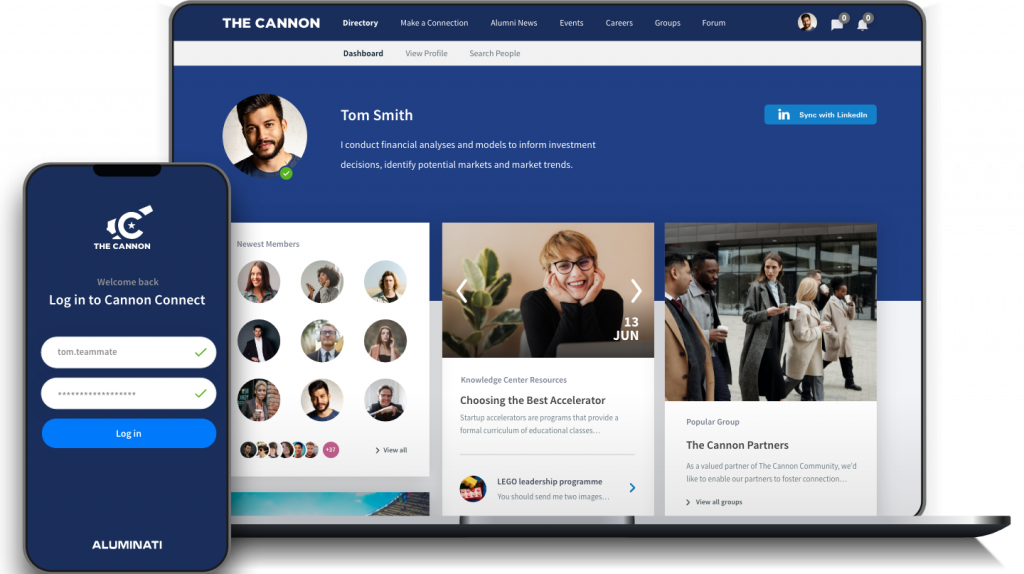
Measuring the success of your alumni engagement strategies
Track and monitor your alumni engagement strategies to measure their success.
Our analytics and Insights will show you what your alumni interact with most. This will allow you to refine your engagement strategies and reignite alumni engagement.
Watch your alumni engagement skyrocket with Aluminate
Alumni dormancy is most often due to a lack of engagement, and several factors can reduce engagement in your alumni network. If your engagement efforts have not produced the results you’d hoped for, don’t despair. Reviving alumni engagement is easy with Aluminati.
You can use Aluminate for Enterprise or Aluminate for Education to build a strong alumni network from scratch, or reignite alumni engagement. It offers the user-friendliness your alumni need, with the versatility your organization needs. Request your demo today.
The post Reactivating Dormant Alumni: Strategies to Reignite Alumni Engagement appeared first on Aluminati Network Group.
]]>