The post How has COVID-19 affected your Community Engagement? appeared first on Aluminati Network Group.
]]>An analysis of over 70,000 community members
Our April Creating Connection virtual Roundtable event brought together members of our Community Builders network to discuss the impact of the COVID-19 pandemic on community engagement.
Subscribe to receive updates when we publish new and interesting content.

Helio Flores, Data Analyst and Johana Canda-Fiserova, our Strategic Engagement Consultant here at Aluminati recently undertook an analysis of over 70,000 community members across our Aluminate Community Builder platforms to see what impact the global pandemic had had on user engagement levels.
Why is this significant?
As of April 2021, it has been just over a year since COVID-19 was declared a pandemic and at Aluminati we place great value in constantly evaluating our work especially at such a significant time. It is important to look at quantitative data to allow for an informed analysis of our communities behaviours.

What is a community?
Nadya Pohran, PhD is a cultural anthropologist, writer, educator and creative strategist. Her work is grounded in empathy and human-centred design principles. She helps individuals and communities to see the world from new perspectives, creating and implementing solutions to problems.
In her recent series on community, Nadya noted that communities existed before the pandemic, and will be around long after. She argued that in many contexts, it’s not what you know, but who you know.
“In the midst of this widespread focus on community across all sectors of life, it’s important that we really understand (and are implementing!) what it means to be a community, rather than just paying lip-service to the concept.
Firstly, a community is more than a group of people. You might be familiar with the age-old maxim “there’s strength in numbers.” This saying is often used to convey the power of a community. But anyone who has been in an over-crowded supermarket, or a maxed-out train carriage, knows without a doubt that strength doesn’t come from sheer numbers alone; strength only comes when the individuals involved decide to intentionally work together towards a common goal. Strength comes from intention, connection, and active engagement. “ – Nadya Pohran, PhD.
Good communities are built strategically so that individuals will want to actively participate within them. For this to happen it is essential that the community structure is human-centric.

Analysis Approach
With the UK and much of the world living under government-imposed Coronavirus restrictions in 2020/21, the impact on traditional communication dynamics across all factors of life, work and education has been significant. Our data analysis contrasts the changing behaviours of users across our Aluminate Community Builder platforms from April 2019 to February 2021.

Pre-Pandemic Trends
Helio noted that it is normal to observe a year on year decrease in registrations and consequently a reduction in additional engagement as a service matures. The reasons for this ‘normal’ trend can be:
- The population capacity affects each service’s capacity for growth. As the proportion of a population who sign up, volunteer etc. grows, the growth rate slows.
- Typical, the most promotion occurs at the beginning of a community platform’s lifecycle, causing increased activity in the early years.

The Results
Whist baseline metrics across engagement platforms continued to reduce during the Covid period, the rate at which they decreased on the Pre-Covid period was significantly lower than normal, with net gains of 34.20% and 23.48% for registrations and logins, respectively.
Our engagement metrics, on the other hand, experienced a reversal of trend, with a substantial increase in activity during the Covid period vs Pre-Covid period. There does appear to have been a significant influence on engagement activity with higher rates of volunteering, higher rates of mentor utilisation and more messaging activity within those newly formed relationships.
This higher propensity for engagement may be down to the personal effects of the pandemic restrictions on students and alumni, in particular the loss of other avenues of connection and communication. This is perhaps supported further by examining the intra-year figures across our engagement metrics (see below), which revealed differences between the Covid and Pre-Covid period were at their peak during the first 3 to 6 months of the Covid period when the proclivity to seek other avenues to connect and communicate may have been at their highest.

What does the future hold?
How can we best meet our strategic goals and community priorities in this new normal? Can we return to the old normal or is a hybrid model of delivery the best way forward for our communities?
There is no doubt that the global pandemic has accelerated the adoption of digital technologies for their community platforms and this, in turn, has led to some interesting new opportunities for engagement and Johana argued that a human-centred approach will lead to increased community engagement but also community longevity.
Find out how the Aluminate Community Builder can help your community thrive, whatever its needs and scalability requirements.
Download our white paper The impact of COVID-19 on user engagement levels within established digital community platforms.
The post How has COVID-19 affected your Community Engagement? appeared first on Aluminati Network Group.
]]>The post Study: The Impact of COVID-19 on User Engagement Levels within Established Aluminate Platforms appeared first on Aluminati Network Group.
]]>
A study of 144,933 users, April-August 2020 vs 2019
Baseline user adoption holds steady whilst engagement and interaction behaviours increase 45-126%
Analysis Summary
With the UK and much of the rest of the world under government-imposed pandemic restrictions, the impact on traditional communication dynamics across work, education and social interactions has been significant. This analysis contrasts the changing behaviours of users on Aluminati’s higher education platforms, comparing the period of April-August 2020 with the same period the year before.
Considerations
The UK officially went into lockdown at the end of March 2020. Our clients being predominantly UK based, we evaluated our dataset between April and August – the last month before the start of the 2020-21 academic year, thus eliminating the seasonal start-of-term effects. This analysis also controls for the substantial early-growth activity that results from new services launches by excluding all services that launched in either 2019 or 2020. The data remaining reflects mature services with typically steady year-to-year metrics with any change observed being likely to reflect from the unique pandemic situation in 2020.
Baseline User Metrics
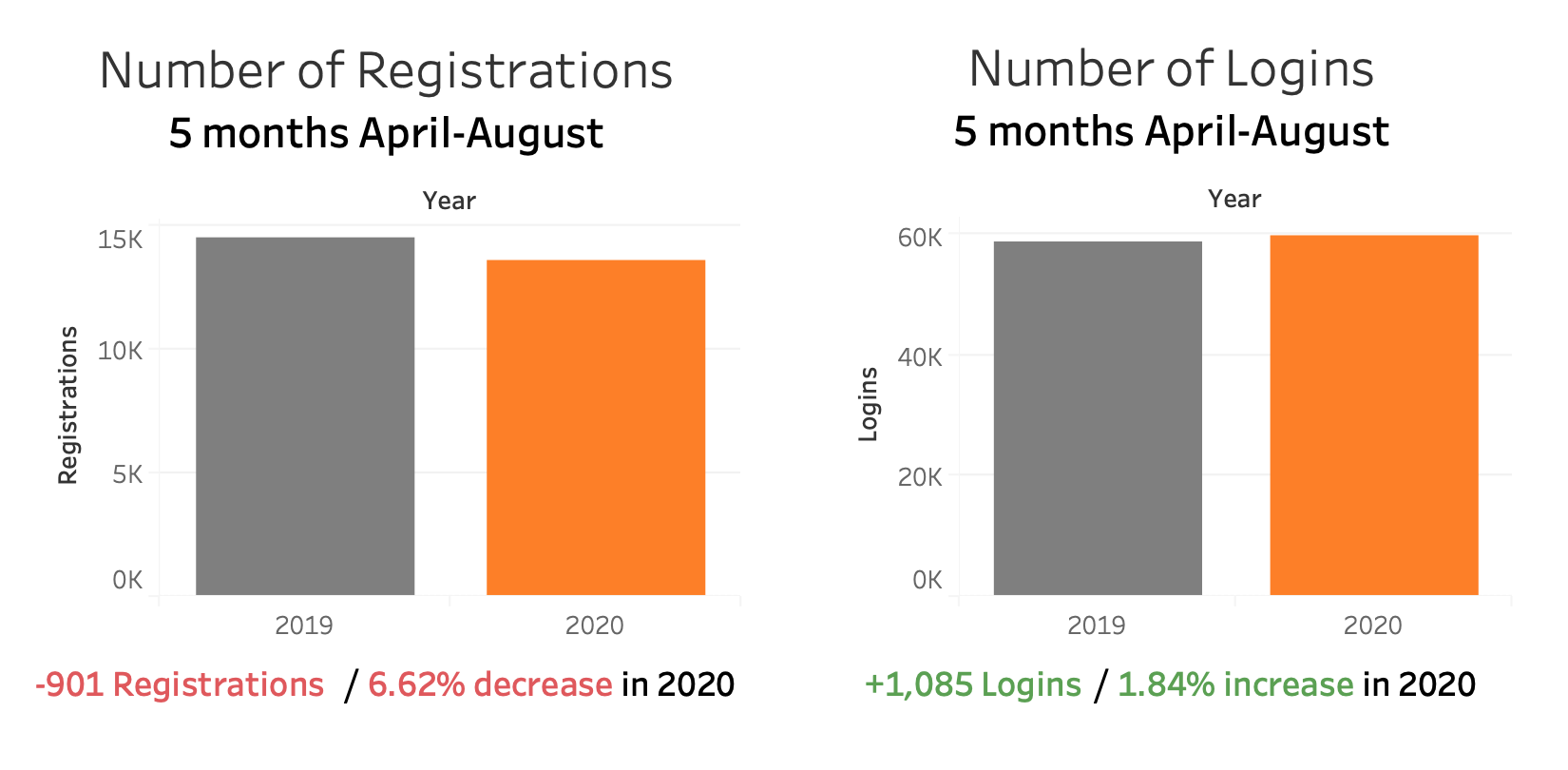
These metrics indicate baseline user interest in the service itself, rather than impactful community behaviours that occur once within the platform. Both metrics held fairly steady year on year. With the loss of the summer term, we had expected to see a more significant dip in registrations given the disruption to key marketing opportunities at and around graduation ceremonies.
 Engagement Metrics
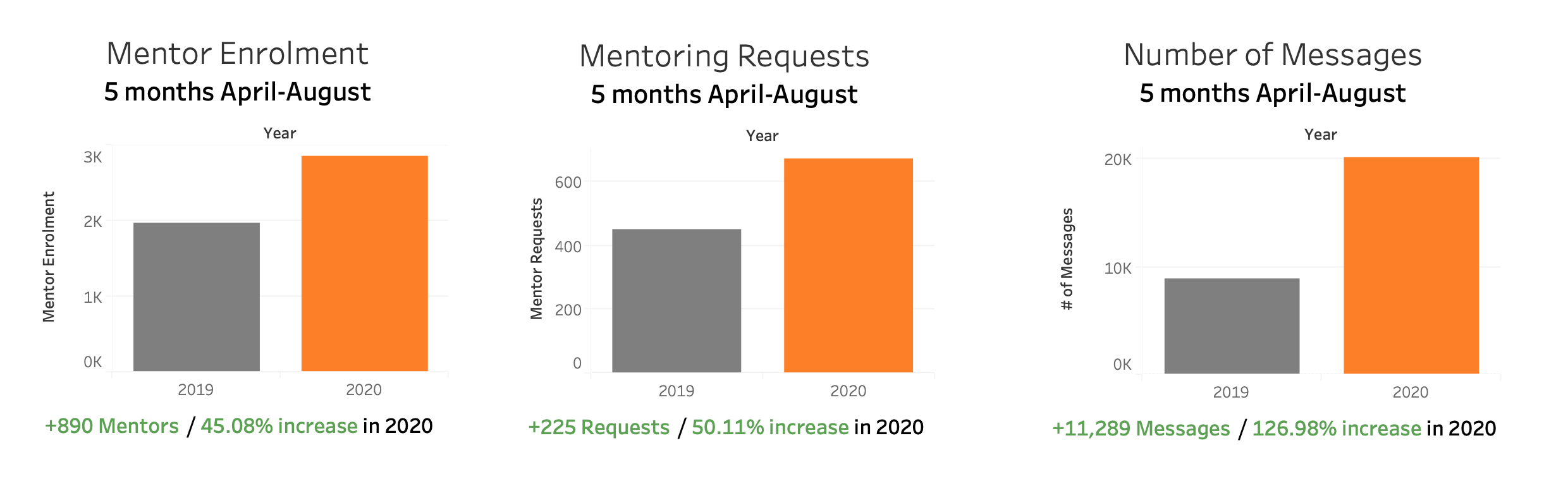
These metrics reflect the more significant interactions between users: Volunteering to be a mentor, requesting a mentor and exchanging messages. Significant increases were observed across all interactions.
Findings
Despite the difficult summer for 2020 graduates, interest in the engagement platforms held mostly steady with only a 6.62% dip in new registrations year on year and login rates holding steady. There does appear to have been a significant influence on engagement activity with higher rates of volunteering, higher rates of mentor utilisation and more messaging activity within those newly formed relationships.
This higher propensity for engagement may be down to the personal effects of the pandemic restrictions on students and alumni, in particular the loss of other avenues of connection and communication. One should also consider the effects of increased activity by universities in promoting online channels such as the Aluminate platform, although if this was significant it should probably have reflected in higher sign-up rates.
It seems reasonable therefore to attribute an intrinsic reason for this change in engagement – that being that digital communications spaces are fulfilling an increased need by our platform members.
You may wish to consider if your digital solutions are fulfilling this need for members of your institution. If not, perhaps you would like to have a look at the platform that generated the above engagement statistics, our Aluminate Community Builder.
Another Aluminati White Paper you might like: The Effects of Mentoring on Employability
The post Study: The Impact of COVID-19 on User Engagement Levels within Established Aluminate Platforms appeared first on Aluminati Network Group.
]]>The post Creating Connection Roundtable #8: The Positive Impact of Mentoring Programs on Employability appeared first on Aluminati Network Group.
]]>SPOTLIGHT:
Helio Flores, Data Analyst – Alunimat Network Group
Mentoring improves the employability of University Graduates.
Helio described the datasets and definitions for the methodology for the study. This data is available as a separate document. Maria commented on how inspiring this was that the positive data was showing with an open platform. Advised to prepare mentors for the power that they will have as mentors.
Johana appreciated the direct impact on mentoring and the power it has and how much more can be done if the mentor programme was opened up to more people. Secondly, if this is taken back to basics it will show the value in volunteering and giving back to the university and the power of the alumni network of an institution.
Q&A
How did this data meet with your expectations and how does it relate to your own experiences?
Q – Really exciting data. How was employment monitored?
A – The ACB platform monitors employment through LinkedIn data sync.
Q – Is the facility in place for institutions to track their own employment data?
A – Aluminati is currently working to enrich the data. More advanced data points will be available in the future.
Q – Interested in showing the data based on student backgrounds and employability.
A – Students from scholarships really benefit from mentoring as the mentors feel more invested in the process.
Q – Was a difference seen between new and more established programmes. How quickly can these results be seen?
A – Results usually take 6 months to a year for results to be seen and depends a lot on the promotion from the institution
A – Success can be clear in the first year but does depend on how well the programme is launched.
Q – Was data taken from the open-access platform?
A – Data was taken from the primary mentoring module
A – These results are made even more powerful as the mentoring programme is the low input model.
Q – How can data analysis be replicated by institutions?
A – Data is available to institutions from their own platforms and how to get the most out of this will be covered in more depth at another round table.
Dan – Summarised how the data might be leveraged. Perhaps presenting a more dynamic perspective. Data can be leveraged internally to engage more with students. Using words such as accelerator / Incubator.
Q – Students and Alumni use the platform to make connections but go elsewhere to continue their conversations such as email. Any advice on getting users to continue using the platform instead of external mediums.
A – Use check-ins in the platform to draw the conversations back to the platform. Add resources to encourage visits back to the platform too.
A – Some institutions used restrictions on sharing external contact details such as mobile numbers but saw push back from Alumni so there needs to be a balance between institution needs and encouraging best mentoring practices.
Download the White Paper
The post Creating Connection Roundtable #8: The Positive Impact of Mentoring Programs on Employability appeared first on Aluminati Network Group.
]]>