The post Why Data is Crucial to your Alumni Relations Success appeared first on Aluminati Network Group.
]]>Subscribe to receive updates when we publish new and interesting content.
“Data is at the core of everything we do. It helps us make strategic decisions, it informs our messaging and outreach and it often helps us to tell our story” TJ Rawlinson, Director of Development & Alumni Relations, Cardiff University, UK.

What to Measure
When asking the question of what is a measure of success in alumni relations, the department’s strategy and the institution’s goals as a whole should be considered. Is ‘engagement’ the right measure? Is it a goal? How is engagement measured? Is it volunteer hours or event attendance? What about email open rates or donations?
Whilst these are all important metrics to consider, an institution must first define what it wants from its alumni. Fundraising departments will use metrics like the number of meetings held and the amount of money raised, but measuring engagement is probably the most effective product that an alumni relations team can generate to add value to the rest of the university.
Christian Propper, Head of Development – Marketing and Insights at the University of Oxford, UK argued that telling a story, demonstrating progress and showing how alumni are getting more engaged are factors institutions can use and can help prioritise ways of generating yet further engagement.
Gethin James, Head of Strategic CRM at UCL, UK noted that engagement is usually portrayed as a counter to an income metric but argued that it is more often not the opposite, but more a means towards an end, or in fact, many different ends. An institution may have goals focussed on marketing, recruitment, campaigns and research and these are all things that one can drive engagement towards. So the first question an institution can ask itself is, ‘What are we trying to achieve?’ and ‘How will we know if it is successful?’

Which comes first? The data or the action?
Data from Cardiff University showed that the institution saw most engagement from younger alumni, which suggested that their planned regular giving campaign may not be as effective as hoped due to the lower engagement in older age groups. This is an example of where having the data first can help form ideas and plan outcomes effectively.
Gethin argued that data sets are rarely a clear cut scenario and that if an institution does not have the data, the most important next step is to start off small, run test campaigns and make incremental changes accordingly as fresh data is generated. “Interrogate what you think you know is true. Don’t assume that event attendees or volunteers will automatically become donors”.
Christian Propper shared some data from a grammar school in New Zealand. They gave 20 years worth of fundraising data to a data analyst to calculate the influence of each engagement variable on the likelihood of someone to donate. The results showed that the likelihood of becoming a donor increased by:
- 327% per event attended
- 288% per email communication
- 41% if they read a high proportion of school emails
- 47% if they had an award or honour whilst at school
- 280% if they took part in the community business directory
- 335% if they’d viewed the fundraising information on the school website
- 200% if they viewed the archives

What is the next best action?
Generally, the common approach to marketing is to start with a product that you have, look at your audience and then decide who are the most appropriate audience members to receive communications around that product. More often than not you will find that it will generally be the same audience members who are the best people to hear about a variety of products. Those audience members will be the ones who show a higher level of engagement than others.
This group of people will then start to receive a large volume of communications for a variety of products that you have to offer.
The model of ‘next best action’ changes this thought process, focussing on the person receiving the communications, rather than the product itself. Gethin James argued that it is problematic that institutions teams are often based around the product rather than the person. He also argued that institutions should use the data to identify what the next best communication is, rather than just sending communications because the alumni have a proven history of engagement. If an institution does not have enough alumni behavioural data to do this, it was argued to start small, use a test cohort, and progress from there.
Conclusion
The panel argued that whatever an institution does, it should find a way to record the behaviour that its alumni are exhibiting. This will help drive the university forward.
Gethin James added that if an institution has in house data specialists, tell them what the universities goals are and ask how they might help track and monitor these.
Aluminati was proud to sponsor the Alumni Relations Institute 2021 conference hosted by CASE. Held in February 2021, it featured talks covering various topics, with panels of industry leaders and experts leading the conversations. This is the fourth in a series of articles from this conference. Check out the previous article in this series Maintaining Alumni Engagement During a Pandemic.
Subscribe to receive updates when we publish new and interesting content.
The Aluminate Community Builder puts your institution’s data at the heart of it. Find out how we can help your institution grow alumni engagement.
The post Why Data is Crucial to your Alumni Relations Success appeared first on Aluminati Network Group.
]]>The post Maintaining Alumni Engagement During a Pandemic appeared first on Aluminati Network Group.
]]>Subscribe to receive updates when we publish new and interesting content.
2020 saw institutions around the world forced to drastically rethink their alumni event programmes. With ‘In-person’ no longer a possibility, many universities moved their events online. We learned from a panel of representatives from institutions how they have been responding to the changes and thinking outside the box, the bravery, courage and innovation to rise to the challenge.
Dublin City University
Dublin City University hosted an annual Alumni Awards ceremony, designed to bring students and alumni together. This is usually a black-tie event and much anticipated throughout the year. Their awards are split into two categories, Alumni Awards and Outstanding Achievements. In 2019 the event attracted approximately 300 attendees including staff, graduates and awardees.
“At DCU we are dedicated to ‘Transforming Lives and Society’. In honouring our extraordinary graduates, we renew the commitment to our great mission, and we celebrate our graduates as an inspiration to students, staff, and supporters”. Professor Daire Keogh, DCU President.
The COVID-19 pandemic in 2020 forced the university to switch to an online nomination system and bringing in a production company to produce an online event. The whole production took around two months rather than the usual nine and saw cost savings of up to 68% when compared to the original in-person format.
Whilst it was agreed that dressing up for an event is great fun, the online event actually reached a much larger audience and a hybrid style event is being planned for the future.
Trinity College Cambridge
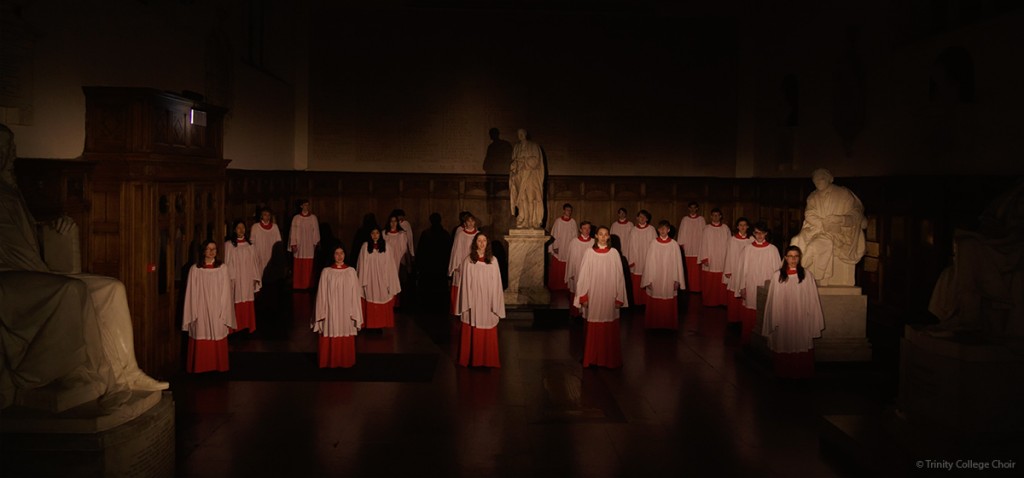
Trinity College saw their Christmas carol service thrown into turmoil in the last half of 2020. In previous years their long-running format saw over 500 attendees congregating for mince pies, mulled wine, champagne and of course, carols. The college has always stated that the event was not seen as a fundraising opportunity and merely as a much enjoyed, highly social annual event. In 2020 instead of ‘Oh Come All Ye Faithful’ they opted for ‘Oh Come All Ye Digital’ with the church-based event being replaced with a living room concert and pre-recorded performances from all over the world.
The college noted five key takeaways from their 2020 event:
- A hybrid of in-person and online events would be programmed in future to ensure inclusivity for all global alumni who wish to attend
- The College would consider how to make this approach sustainable
- Opportunities will be developed to surprise alumni and supporters
- They would measure the success of future virtual events
- Look into developing social events further as they move forward
University College Dublin
University College Dublin hosts an annual three-day celebration showcase designed to bring the local UCD community together. Their 2019 event took five months of planning with 170 events including talks, showcases and workshops. The event saw 22,500 participants over three days with over 600 volunteers taking part. There were a few specific global events organised such as chapter barbecues etc but the event focussed primarily on its local area.
Their pandemic pivot brought new challenges. There was less support for the event from the wider university community, whose focus was primarily on student learning. The planning committee had little experience with running online events and realistic expectations had to be set. In the end, the event only used 50% of its budget and all the online events were pre-recorded.
The college’s 2020 UCD Festival took a mere 5 weeks of planning and saw 22,500 visitors over three days with an astounding 1.5 million impressions and engagement from 58 countries around the world. The event set a precedent that large-scale events could successfully move online and retain the festival spirit.
There are many ways that institutions can engage with their alumni, however, sometimes a new way of thinking can bring surprising and positive outcomes. These examples of pandemic positives can be found at institutions all over the world as they navigate through the uncertain territory. Whilst the world may never be the same again, it goes to show that it doesn’t necessarily have to be.
Aluminati was proud to sponsor the Alumni Relations Institute 2021 conference hosted by CASE. Held in February 2021, it featured talks covering various topics, with panels of industry leaders and experts leading the conversations. This is the third in a series of articles from this conference. Be sure to check out the previous article in this series, How to Create an Agile Alumni Relations Strategy.
Find out how Aluminati can help your institution’s alumni community thrive.
Subscribe to receive updates when we publish new and interesting content.
The post Maintaining Alumni Engagement During a Pandemic appeared first on Aluminati Network Group.
]]>The post How to Create an Agile Alumni Relations Strategy appeared first on Aluminati Network Group.
]]>Aluminati was proud to sponsor the Alumni Relations Institute 2021 conference hosted by CASE. Held in February 2021, it featured talks covering various topics, with panels of industry leaders and experts leading the conversations. This is the second in a series of articles from this conference. Click here to read the first article.
Subscribe to receive updates when we publish new and interesting content.
Christine Fairchild, Director of Alumni Relations at the University of Oxford, UK was kind enough to join the panel at this recent CASE event to offer her insights into how to create an agile Alumni Relations strategy.
Why are strategies important?

Having a clearly articulated alumni relations strategy is an absolutely essential factor for any institution. A strategy will provide a common purpose with shared and articulated goals. A plan of action will provide a university and its staff a clear path forward, allowing for the sensible allocation of resources within a manageable time frame.
From this, the path to success will be visible to all and an alumni relations department’s contributions to the institution as a whole will be more effectively articulated. Not just a path to success, but highlighting what not to do at the same time.
A solid blueprint will inform staff development, find strengths and gaps, identify partnerships and encourage an institution to keep pace with the changes happening.
Achieving success with a phased approach
Christine argued that there are five phases in the strategy development process:

Phase 1: Identify and clarify the challenges and tasks.
Environmental Scan
SWOT Analysis
Stakeholder Identification
Take a holistic look at the department and institution to get a better sense of a road map moving forward. Identify who might stand to benefit from the strategy as a resource. This can help to tell an effective story if the benefits are made clear from the start. For example, if part of the strategy is to encourage alumni to help identify new students to apply to the university, this will help the institution’s admissions department.

Phase 2: Gather and analyse data.
Personal Interviews
Focus Groups
Surveys
Peer and Market Analysis
Benchmarking
Phase two is the perfect opportunity to involve all stakeholders to raise their stakes in the game, so to speak. Focus groups are an incredibly valuable way to find out how audiences are feeling and what their perceptions of the institution might be.
Christine noted that it is important that institutions remain competitive by learning from other institutions but also argued against keeping peer analysis too predictable. For example, a large charity such as the Red Cross may have similar goals to an institution and would provide interesting insights.

Phase 3: Synthesis data, form vision and goals
Discern Mission, core purpose and shared values (What will we do?)
Vision (Where do we want to be in 3 to 5 years?)
Goals (What are our aspirations?)
Create a Strategy Statement
Be clear about embedding the institution’s mission into the strategy and constantly reinforce it, focussing on shared values. Christine argued that an institution’s goals should always be aspirational as it is ‘good for business’. The notion of completing a goal and thinking of ways it can be done better. Keeping goals at this aspirational level can keep an institution working harder and be more engaged in the outcomes.
Christine noted that having a clear strategy statement will crystalise those expectations.

Phase 4: Develop measurable objectives.
Action Steps
Timeline
Accountability
Allocation of Resources
Christine noted that an institution must be clear about who it is relying on to ensure that the strategic plan is being delivered and that it is clear what the universities expectations are of them.

Phase 5: Plan, seek buy-in and approvals, implement, assess, report.
Socialise the plan with key stakeholders and influencers
Follow through on action steps
Evaluate and make adjustments needed
Report
“The most important thing to do is bring people along with you”, Christine remarked. “Bring people in from all across the university, from top to bottom, and include other stakeholders such as the alumni board”.
It is important to involve as many people as possible in this fifth phase. Show people throughout the process that goals are being achieved and show progress. The institution must constantly hold itself accountable for evaluation and make any necessary changes as the strategy moves forward.
Reporting gives stakeholders a chance to celebrate what has been achieved and is a great form of socialising the work that is being done.
Find out how Aluminate Community Builder can help supercharge your institution’s alumni relations strategy.
Subscribe to receive updates when we publish new and interesting content.
The post How to Create an Agile Alumni Relations Strategy appeared first on Aluminati Network Group.
]]>The post AI & AR – Alumni relations in the 21st Century: How to Train your Storytelling Algorithm appeared first on Aluminati Network Group.
]]>Get updates when we publish new and interesting content.
Professor Alex Connock, Fellow in Management Practice, Said Business School, University of Oxford, UK discussed how institutions should consider their communications strategy and offered some thoughts on storytelling and distribution in the 2020s. He argued that Alumni Relations is not just about getting money out of wealthy graduates but providing an environment where alumni can continue their education, long after they leave university.

AI for AR
“Predictive analytics is a broad term describing a variety of statistical and analytical techniques used to develop the models that predict future events or behaviours” – Predictive Analytics White Paper – Charles Nyce, PhD, CPCU, API 2007
Professor Connock argued that we are in a predictive algorithm economy. “Everyone’s Netflix profile is different…” he noted. No offering is the same for each account on the streaming service. If you watch romantic comedies, you will find that more often than not, that is what will be offered to you in the future. This was to such an extent that Alex has another entirely separate profile on Netflix, just so that he would be suggested different things to watch. The same can be said for the music streaming giant, Spotify and it is no accident that these two providers are the main players in their sectors. They are much better at utilising Artificial Intelligence than their competitors.
What is A.I?
As far back as 1950, Alan Turing’s paper, Computing Machinery and Intelligence considered the idea of machine learning and artificial intelligence, yet it is only now that A.I. is coming into its own, Professor Connock argued. Artificial intelligence can be found everywhere in modern-day storytelling and the stories being told are not for the masses anymore. Today’s stories are being told to the individual, on a granular level.
Marketing agencies around the world use a practice of Dynamic Creative Optimisation (DCO) which is A/B testing on a much grander scale. An A.I. algorithm will create thousands of different versions of an advertisement, testing them all simultaneously to find out which one works best for each person that sees it.
What this allows for is more creative storytelling which is especially important with alumni communications where institutions must maintain a distinctive message to remain engaging and stay relevant. Professor Connock argued that alumni are holding their universities more accountable with their data. The expectation is for them to use it more creatively, understanding the end-user better to deliver what is meaningful to them, and to avoid falling into storytelling clichés.
“Ever tried. Ever failed. No matter. Try again. Fail again. Fail better.” – Samuel Beckett
Professor Connock stressed the importance to institutions that when storytelling to never stop testing and never stop learning. Keep trying different content until it works. He argued that when benchmarking it was just as important for an institution to compare itself to others but also to other sectors entirely. For example, a large multinational charity might be striving for similar goals and it would be prudent to compare their methods to your own.
Professor Connock also argued that by all means, use the data that you have generated as an institution, but also, listen to the voices of your alumni.

Effective Storytelling
As time was limited, Professor Connock was only able to communicate the first four of his many rules for effective storytelling, but we hope to catch up with him again soon for the rest.
Be Authentic
Many organisations and institutions will use generic tropes and fall into the above-mentioned storytelling cliches. Alumni will not engage if an institution does not stand out.
Be consistent
It is important to have a ‘central brain’ to make sure an institution’s messaging is consistent across all channels but also to remain consistent within each channel. It is important to consider which messaging platforms require different tones for effective communications.
Bring passion to your communications
The more passionate an institution is with its communications, the more its alumni will engage. It is important to make sure that the messages are not purely functional. Passion is contagious and alumni naturally have a passion for their alma mater. Institutions must listen to what people are saying about them and put a persona behind their communications.
Learn the dark art of earned media
The more an institution can get other people to do the work for them, the better. Finding out what their alumni are achieving and what is worth talking about is critical to fostering success with your audiences and community.
Find out how Aluminate Community Builder can bring your Alumni community together.
The post AI & AR – Alumni relations in the 21st Century: How to Train your Storytelling Algorithm appeared first on Aluminati Network Group.
]]>The post Creating an Alumni Community in a Changing World appeared first on Aluminati Network Group.
]]>A brand-new alumni team started at Regent’s in January 2020 with the vision of creating an engaging alumni programme from scratch. After two months of building their strategy, their direction had to change dramatically overnight when the pandemic hit the UK. In this session, Hannah reflected on how Regents responded to the challenges that COVID-19 brought, how they got the programme off the ground remotely, and how they turned challenges into positives which eventually led to a successful outcome.
At the time of writing, Hannah had worked in the sector for 9 years, starting at UCL before spending 5 years in various alumni engagement and fundraising roles at London Business School.

A Fresh Start
Regent’s University is a beautiful and reasonably small, private institution, with 6000 London based students and 450 staff members. Before the 2020 COVID-19 pandemic, the university’s alumni relations programme had been running for just over a year. In 2019, Regent’s decided to put further investment into its alumni relations and make the programme more central to the other activities at the university.
Hannah Fox joined the team in early 2020 and in her November 2019 job interview she suggested that the programme would effectively be starting from scratch stating “in an ideal world, you would love to take a year off from all your other activities and be able to spend that year talking to people”.

So there they were, in January 2020 with a new team, a new direction and a new ‘strategy’. Whilst the strategy was new to Regent’s University, it was already tried and tested at other institutions and Hannah set about to implement this proven strategy at Regent’s.
Although the university’s student-alumni body was 85% international, the consensus was that a brand-new alumni relations programme should involve a great deal of physical interaction between the department and its alumni. This meant bringing people back to the main campus and recreating that nostalgic feeling, or working with the VC and recruitment team to go to international locations to be present for their alumni.
With this in mind, on 1st of March 2020, Hannah and her team had a class reunion planned; a series of recruitment events planned across the West Coast of the US with several alumni volunteers already signed up to assist; a large ‘global speakers’ series underway with over 100 people attending campus events and the university had just launched its Campus Access Card which allowed alumni to access the campus and its resources for work or research purposes.
“Things were good, and things were on track…and then the 16th March came along!” Hannah Fox.
Lockdown
The first UK nationwide lockdown came into immediate effect. For Hannah and her team, this meant no events, no travel and more importantly, no face to face meetings.
Overnight, their entire strategy from creating volunteer opportunities, planning events, creating networks and bringing people together had to take a whole new direction.
The one thing the team still had left in their arsenal was the ability to talk to people and that became the sole focus moving forward. With no knowledge on how long the lockdown was going to last, they established some new goals.
- To discover and share great alumni stories.
- Get internal ‘buy-in’ for the programme at the University amongst their other professional services colleagues.
- Work with the University’s academics to find hidden alumni who were already engaging with the institution but not necessarily the alumni department.
Hannah noted that from these conversations, they were able to find out so much more than originally anticipated.

It’s Good To Talk
The alumni relations team found they were able to engage with a great number of ‘cold alumni’ who had not been engaged with the university for five, ten or even fifteen years. Lots of these newly engaged alumni then went on to sign up for the departments volunteering programme, which allowed Hannah to move the programme online.
“These conversations with our alumni really helped us to shape the future of the programme”, said Hannah, “we were having so many feedback conversations, asking alumni what they would like to see from the programme, and we really did find the most amazing alumni stories.”

The Buy-In
The team’s conversations with the institution’s professional services staff saw a huge change in attitude around alumni. Pre-pandemic conversations would more often than not focus on staff, students and faculty and slowly but surely, conversations started to include alumni when discussing the greater Regent’s community.
The university’s senior leadership also began to see alumni as stakeholders when it came to areas such as course design, curriculum contribution or overall strategy. Regent’s was able to engage with these key sector leaders within their alumni community to shape the strategy for the university. Hannah noted that colleagues started really seeing the potential of their alumni. The university’s conversion officers were able to connect students with alumni easily online and because of these positive interactions, Regent’s ambassador programme grew.
Hannah’s team were also able to engage with already engaged alumni alongside the faculty, creating some fantastic opportunities for them, which really strengthened existing opportunities throughout the university.

Positive Change
Hannah and her team may have been thrown in at the deep end but the changes they experienced also led to newfound opportunities. They were able to have quick ‘coffee chats’ with alumni all over the world. Alumni videos were easier to produce due to a lack of expectation for high production values during the lockdown. They also saw an increase in alumni online volunteering globally, simply because it was so much more accessible.
With a team of just two, the Regent’s University Alumni Relations department were able to have over 200 individual virtual coffees with their alumni, recruiting 139 new alumni volunteers and accruing over 700 volunteering hours across 2020.
“We have been able to engage with more of the Regent’s community in a more meaningful way. We’ve had time to ask questions and find out answers without the pressure of developing on a pre-formed strategy too.” Hannah said, “It’s shown us that authenticity (aka rough and ready) can actually be a good thing and it has encouraged us to simplify our strategy moving forward”.

Creating Connections
Our Creating Connection events at Aluminati bring together community builders from a range of sectors around the world to learn from each other.
For more information or to sign up to the Community Builders network: https://www.aluminati.net/community-builders-network/
Sign up for our next Creating Connection event: https://www.aluminati.net/creating-connection/
The post Creating an Alumni Community in a Changing World appeared first on Aluminati Network Group.
]]>The post CodeVA signs on with Aluminate Community Builder appeared first on Aluminati Network Group.
]]>CodeVA is a non-profit organisation, based in Richmond, Virginia, USA, that partners with schools, parents and communities to bring equitable access to computer science education to students across the state. It is founded on the principle that “anyone can code, and that every Virginia child has a fundamental right to computer science literacy”.
Why Aluminati?
CodeVA needed a more robust space for educators to collaborate and access materials during their annual training event. In addition, the company is currently working on a federally funded research project that consists of a cohort of rural school teachers from regions all across Virginia. CodeVA needed space for them all to collaborate and work together, receive training materials, and continue the discussion.
“We appreciated the Aluminate Community Builder’s ability to export data and content, its security with member logins and being COPPA Security Compliant (Children’s Online Privacy Protection Act 1998), the ability to support multiple user types, the ability to allow for multiple types of engagement (forums, discussions, events), and the ability to host multimedia extensions and learning modules”. – Betsy Seymour – Project Lead, CodeVA.
Room for Growth
CodeVA is starting the platform with a small number of users, with plans to grow from there. They are also building the internal support required to nurture a robust and engaging community, hiring a web developer and training content coordinators etc. Betsy said, “We hope to slowly phase out some platforms such as our current online platform and CRM once we get a feel for everything that the Aluminate Community Builder can do”.
Having compared other platform providers, the Aluminate Community Builder was the only one that met all their requirements, price point and build time-line. “We appreciated that the platform has a dedicated development team for the project, full GDPR security policies in place and learning modules baked in”, said Betsy.
Betsy said that teachers who participate in training with CodeVA have requested more opportunities for engagement, collaboration and communication, as well as more access to resources. The vision for their platform is to extend training to all of their cohorts to allow for more authentic and consistent online engagement.
We will be checking back in with CodeVA once their platform is launched.
Find out how Aluminate Community Builder can supercharge your community growth.
The post CodeVA signs on with Aluminate Community Builder appeared first on Aluminati Network Group.
]]>The post ACS International Schools partner with Aluminati to power their online community appeared first on Aluminati Network Group.
]]>ACS International Schools has partnered with Aluminati to build their online student alumni community.
Read the full case study here.
The post ACS International Schools partner with Aluminati to power their online community appeared first on Aluminati Network Group.
]]>The post The Year where Nothing was Normal appeared first on Aluminati Network Group.
]]>2020 saw huge changes to our lives and work. We faced difficult times and hardship. But in spite of all of this, we managed to stay creative in the face of challenge and so have institutions. Institutions that have adapted to serve their alumni in new and innovative ways.
Aluminati was proud to sponsor the Introduction to Advancement Leadership conference hosted by CASE. Held in November and December 2020, it featured talks covering various topics, with panels of industry leaders and experts leading the conversations. Be sure to check out our previous article in this series, Alumni Relations – Shareholders, not Customers.
We met with a panel of speakers who all gave insights into the peaks and pitfalls that came about from the need to do things differently.
Live in Lockdown
Louise Strong, Campaign Events Manager at the University of Durham, UK said that the COVID-19 pandemic forced the cancellation of many alumni events, and they had to find a new way to support their global alumni community. Louise said that it was more important than ever for their institution to maintain a sense of togetherness and with that, bring together their most important resources. The outcome of this was Durham Inspired: Live in Lockdown, which brought together students and alumni from across the world from the safety of their own homes. Since December 2020, Durham University has hosted over 50 online events, with 5500 registrations and 1500 newly engaged alumni across 84 countries.
..
The content was curated around the university’s four key pillars, Learn, Develop, Network and Industry and focussed on career advice, guidance, support and social networking with conversations around industry insights and outcomes.
30 Under 30
Jonathan Goode, Head of Alumni Relations at the University of Bournemouth took inspiration from Forbes Magazine and put the call out to their alumni The aim was to find the thirty most notable alumni under 30 years of age.

The university chose the ‘under 30’ age bracket as these alumni were only a maximum of ten years on from their graduation and could offer more relatable experiences to the institution’s current students. The university launched their appeal, asking for self-nominations online and the shortlisted individuals even saw their employers becoming engaged in the competition to show support. Bournemouth University saw a 296% increase in web traffic during the competition with an astounding 8702% increase in social media engagement across their platforms.
The Alumni Podcast
Glynis Gardner, Alumni Relations at Cork Institute of Technology in Ireland wanted to be able to connect with students and alumni and offer content at a time and place that suited them. After much collaboration with the university’s student engagement office, the team developed a six-episode podcast series and a social media strategy to support it.
The whole project cost in the region of €4500 along with a small investment in recording equipment. They were also given a generous donation of €1000 from the university’s engagement office. The project generated a huge buzz on social media.
Homecoming from Home
Gerard Kennedy, Development and Alumni Relations Manager at the University of Swansea was in the middle of the University’s centenary celebrations and wanted to try to keep the momentum going. Many of their events had already been planned and had people booked in to attend from around the world so Gerard decided on a different approach, the ‘Homecoming from Home’.
The university called on Alumni to dig out old photographs while they had time on their hands at home. Gerard argued that the most important factor in reunions is a sense of nostalgia and for one week, the university shared the images on their alumni platform. The event generated a huge level of engagement with over 300 uploaded photographs and over 400 new registrations to their alumni platform.
A New Way of Connecting
There are so many positive ways to engage with students and alumni, and digital platforms provide a huge advantage to institutions. Community platforms can furnish institutions with great opportunities to connect that might not have been possible before.
Find out how the Aluminate Community Builder can provide new opportunities for your institution and alumni community.
The post The Year where Nothing was Normal appeared first on Aluminati Network Group.
]]>The post Alumni Relations – How to turn your Alumni into Shareholders, not Customers appeared first on Aluminati Network Group.
]]>Aluminati was proud to sponsor the Introduction to Advancement Leadership conference hosted by CASE. Held in November and December 2020, it featured talks covering various topics, with panels of industry leaders and experts leading the conversations. Be sure to check out our previous article in this series Demonstrating the Value of Alumni Relations.
The idea of the student being the customer is deeply ingrained into institutions. This has been normalised through policy, programmes but most poignantly from the expectations of students. This perspective on the institution-student relationship has an unfortunate impact on long term relationships, especially with alumni.
We met with a panel of innovative alumni relations professionals who were championing the idea of “students and alumni and shareholders”.
Dr. Maria Gallo, Founder and Principal Researcher at Keep in Touch Education, Ireland suggested that the origins of ‘students as customers’ has seeped into institutions and had negatively impacted an institution’s ability to foster lifelong relationships with its students, turning them into passive recipients rather than an active, engaged self-directed learners. Maria noted that the circumstances that led to the current situation are extremely complex. High tuition fees, pressure on institutions to retain students, a general funding crisis in the higher education sector, and increased expectations by students with regard to career prospects all play a part.
“Students have drunk this potion and an antidote is needed” – Dr. Maria Gallo
The Dangers of the Transactional Relationship
There is a danger that a transactional approach to the student-institution relationship will lead Alumni to think of their Alma Mater like a one-off product or a single purchase when it should actually be a lifelong experience. Dr. Gallo suggested that the more former students understand their identity as alumni, the more likely it is they will be to engage with the institution throughout their lives. For this to be achieved, institutions must consider building more strategic and meaningful engagement and support frameworks.
The Shareholder Framework
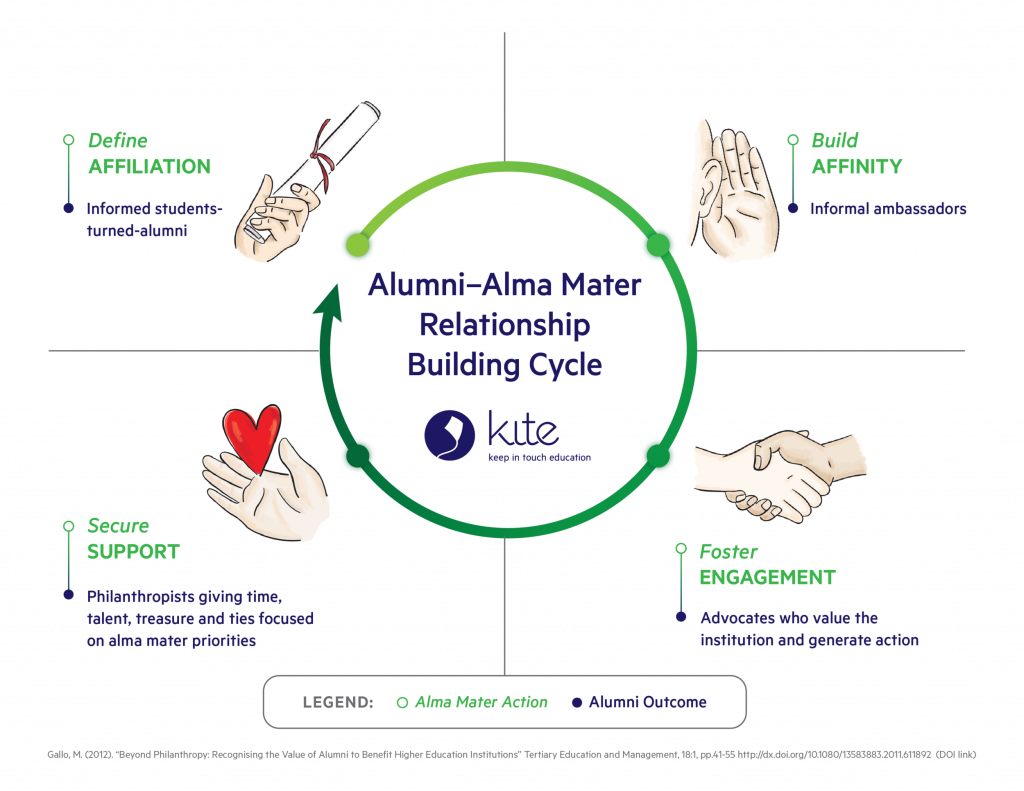
Institutions must recognise that their alumni are distinct stakeholders and as such, the institution has a responsibility to maximise stakeholder value. Dr. Gallo suggested that defining alumni as shareholders can create a huge opportunity for growth for an institution. It was argued that an alumni relations department must earn engagement, not expect it. Institutions must build affinity with their alumni by involving them in curating communications. Engagement must be fostered, taking care to review how the alumni are engaging with the programme and how leaders are being involved. It is key to check in with alumni leaders on a regular basis, finding out how they are finding their experience as an alumni volunteer. Ask them if they know other people who might be interested in the programme.
The 3 steps to radical change
Step 1. Shareholder proof. Think of programmes in place throughout the institution. How are alumni featured within these programmes? Is it clear that they are stakeholders?
Step 2 – Co-create with your alumni. Work with your alumni to create engaging communications.
Step 3 – Identify. Identify key people both internally and externally who can help drive the change you are looking to make.
Find out how the Aluminate Community Builder can help your institution’s Alumni Relations programmes
The post Alumni Relations – How to turn your Alumni into Shareholders, not Customers appeared first on Aluminati Network Group.
]]>The post Demonstrating the Value of Alumni Relations appeared first on Aluminati Network Group.
]]>
Alumni are your institution’s biggest stakeholder group and the living embodiment of your institution’s goals. However, whilst maintaining a world-class alumni relations programme is neither easy nor cheap, failing to invest at all in it will make life harder and be more expensive in the long run.
Alumni Relations programmes have very real goals and should be aligned closely with those of your institution. Typical examples include working with alumni to find advocates, expanding employment opportunities, fundraising, increasing student recruitment and more. This particular event discussed how institutions as a sector can demonstrate the impact of their work by sharing best-practices.
The panel were all asked the same question, Why is Alumni Relations Important?
Ian Moore, Head of Alumni Relations and Annual Giving at the Queen’s University in Belfast said that one of the things he is conscious of is that Alumni are the living embodiment of a university’s product and that whilst knowledge is not something you can see, you can see it being used and the impact they have on the world around them. Alumni are constantly exposing the values that have been instilled in them by their time at university and their success reflects on the institution. Universities need to know who their alumni are, where they are, and what they are doing.
Holly Peterson, Head of Constituency Engagement at the University of London, UK noted that the two main things that an institution produces are alumni and research. Whilst research and fundraising programmes can have more obvious routes to success, alumni relations goals are not as clear cut. Holly suggested that universities have the potential to produce thoughtful humans who use their knowledge to make the world a better place. She also noted that lots of studies have shown that people who receive a university education are more civilly engaged. It is important to see how university affects alumni by staying in touch with them and understanding how they are taking their work into the world.
Any Alumni Relations department must ask themselves what their institution’s goals are, what their alumni engagement strategy is, and how can their alumni help the institution achieve its mission? Many programmes will focus on alumni employability and securing university places for school-leavers. Our recent study, Mentoring Improves the Employability of University Graduates shows how important alumni-student mentoring programmes can be in helping with this goal.
..
Suggestions for ways to increase alumni engagement were to implement regular communication as to what the university is doing with news and upcoming events. It was also suggested that events should be seen as an opportunity to share information with an institution’s alumni base and perhaps prompt further engagement from that point. Events are also a good opportunity to identify notable alumni and make them donors, volunteers or ambassadors for an institution. Virtual events have also become a valuable resource for increasing geographical engagement.
Jimmy Buck, Chief Advancement Officer at Deakin University, Australia, noted that alumni relations programmes were not meant to merely babysit but should focus more on the role of a power broker.
Measurements and KPIs
What measures should we use to demonstrate effectiveness to university leaders and senior stakeholders?
Ian Moore stated that the world of alumni relations is changing and that changes are also occurring in the way alumni relations departments operate.
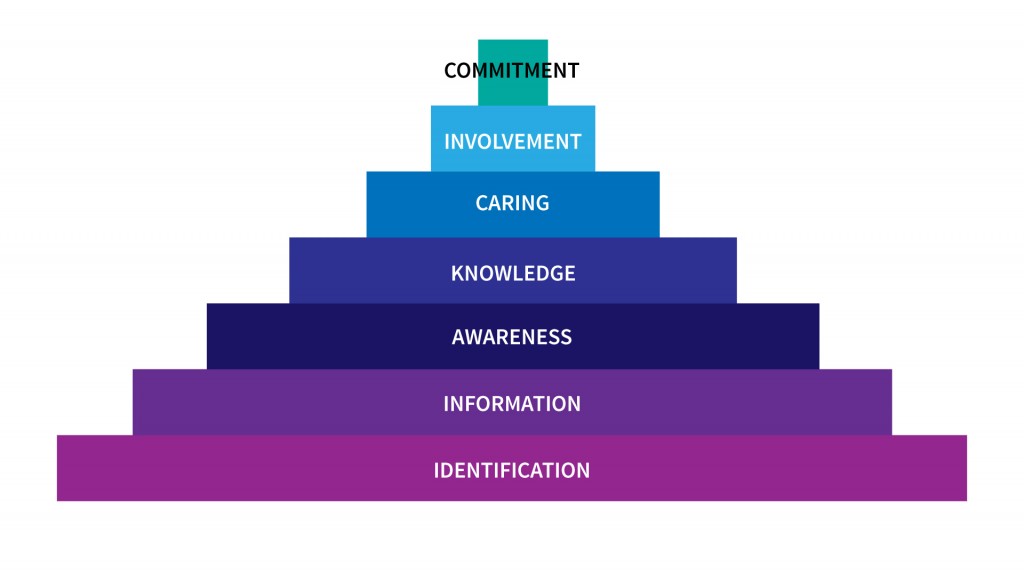
The old model of engagement is linear and makes assumptions that people are the same. Ian argues that people are more complex than this model allows for and that the best way to measure engagement and relationships is to focus more on impact. “Impact is King”, he stated.
How an institution’s goals and bottom-line is supported by these programmes is a crucial measurement of success. It was also noted that it was important to compare engagement levels with those of similar institutions.
Holly Peterson stated that it is also very important to maintain transparency with your alumni as to why you are doing what you are doing. That way, they will be more satisfied with their experience and in turn, be more likely to engage and advocate.
Jimmy Buck noted that pyramid models are good at showing trajectory but when it comes to individual prospects, alumni engagement pathways can go in many directions, much like a tube map. There are a number of ways alumni can add value to an institution, yet no concrete way of measuring this. Alumni relations are constantly evolving and by the time universities have figured out what works, things have moved on.
However, the panel all agreed on the importance of collaboration with other departments within an institution, for example communicating with fundraising departments and student affairs to make sure that everyone is working towards key goals.
As Ian stated at the conference, “Impact is King”.
Aluminati was proud to sponsor the Introduction to Advancement Leadership conference hosted by CASE. Held in November and December 2020, it featured talks covering various topics, with panels of industry leaders and experts leading the conversations. Be sure to check out our previous article in this series Your International Alumni Really Matter – Here’s Why.
Find out how Aluminati can help supercharge the impact of your institution’s alumni relations programmes.
The post Demonstrating the Value of Alumni Relations appeared first on Aluminati Network Group.
]]>